![[tex flag]](../../images/usa_vet.png) Heart of Texas World War One, Rem Bios & Records, Eastland County Texas
Heart of Texas World War One, Rem Bios & Records, Eastland County Texas ![[usa flag]](../../images/tex_flag.png)
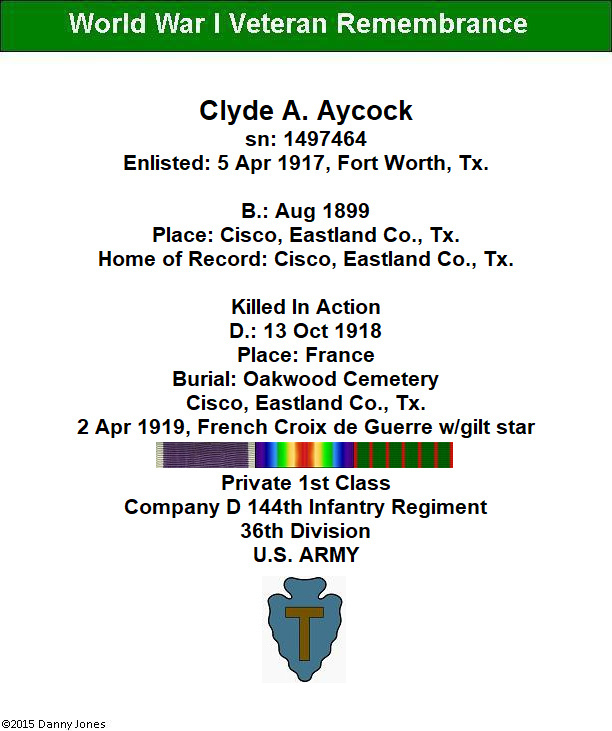
Mr. Clyde A. Aycock, a single white male living in Cisco, Eastland County, Texas and his employment not known as of April 5, 1917. Clyde did not register for the draft. Born in Cisco, Eastland County, Texas in August 1899 to Francis 'Frank' E. and Mary 'Mollie' E. Aycock, and was raised in Eastland County, Texas. Clyde was reported as living with his parents and siblings in JP6 Eastland County, Texas in the 1900 census. Clyde was reported as living with his parents and siblings in Eastland County, Texas in the 1910 census. Clyde's father died in 1912. Clyde's mother of Cisco, Texas is listed as next of kin on his Army record.
Clyde was enlisted into service for the Texas National Guard on April 5, 1917 at Fort Worth, Texas. Recruit Aycock was sent to boot camp at Camp Bowie in Fort Worth. Clyde was given assignment for training to the Company B 4th Infantry Texas National Guard. When the Texas National Guard was put into the US Army about August 20, 1917, Private Aycock was assigned to Company D 144th Infantry Regiment 36th Division at Camp Bowie in Fort Worth. The first units of the 36th Division arrived in France May 31, 1918 and the last on August 14, 1918. Private Aycock's unit moved to Camp Mills, New York then to the port of embarkation in Hoboken New Jersey and boarded the transport ship to France on July 18, 1918 for the eleven day voyage to France. The 36th division was stationed at Bar-sur-Aube until September 26, 1918, conducting training with the French Army. Private Aycock was promoted to Private 1st Class on September 4, 1918. The division's Meuse-Argonne operations began October 7, 1918, and it was between Somme-Py and Givry during this battle that Clyde was killed in action October 13, 1918, and buried near the battlefield. His mother was notified.
![[Army]](../sealArmy.png) Private 1st Class Clyde A. Aycock was buried in a temporary grave there in France to be later repatriated to America. The Graves Registration Service of the US Army was Clyde's new unit. The GRS did an awesome job during and after the battles of WW1. Clyde's remains were loaded onto the USAT Wheaton in Antwerp, Belgium and departed on August 6, 1921 and arrived in Hoboken New Jersey on August 20, 1921. Then shipped September 17, 1921 by train to Cisco, Texas arriving September 23, 1921. Clyde Aycock was laid to rest in the Oakwood Cemetery, Cisco, Eastland County, Texas. Survived by his mother. On April 2, 1919 Private 1st Class Clyde Aycock was awarded posthumously the French Croix de Guerre with gilt star for his courage in battle.
Private 1st Class Clyde A. Aycock was buried in a temporary grave there in France to be later repatriated to America. The Graves Registration Service of the US Army was Clyde's new unit. The GRS did an awesome job during and after the battles of WW1. Clyde's remains were loaded onto the USAT Wheaton in Antwerp, Belgium and departed on August 6, 1921 and arrived in Hoboken New Jersey on August 20, 1921. Then shipped September 17, 1921 by train to Cisco, Texas arriving September 23, 1921. Clyde Aycock was laid to rest in the Oakwood Cemetery, Cisco, Eastland County, Texas. Survived by his mother. On April 2, 1919 Private 1st Class Clyde Aycock was awarded posthumously the French Croix de Guerre with gilt star for his courage in battle.


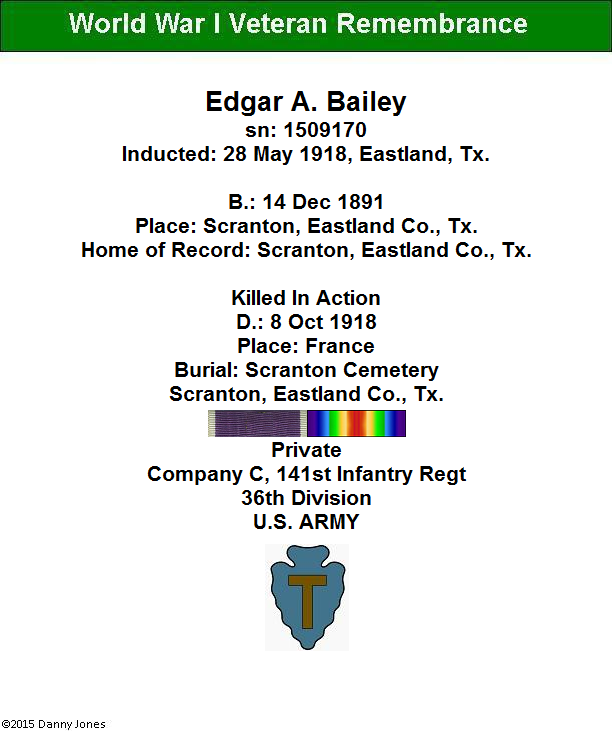
Mr. Edgar Alonzo Bailey, a single white male living in Scranton, Eastland County, Texas and working as a farm laborer for Wiley Clinton as of June 5, 1917. Edgar was tall and medium build with light brown hair and light blue eyes and a tan complexion. Born in Scranton, Eastland County, Texas on December 14, 1891 to George S. D. and Nancy E. Bailey, and was raised in Eastland County, Texas. Edgar was reported as living with his parents and siblings in JP6 Eastland County, Texas in the 1900 census. Edgar's father died in 1901. Edgar 'Lonzo' was reported as living with his mother and siblings in JP6 Eastland County, Texas in the 1910 census. Edgar's mother died in 1913. Edgar's brother, James B. Bailey of Scranton, Texas, is listed as next of kin on his Army record.
Edgar was drafted into federal service for the US Army on May 28, 1918 at Eastland, Texas. Recruit Bailey was sent to boot camp at Camp Bowie in Fort Worth. Private Bailey was assigned to Company C 141st Infantry Regiment 36th Division at Camp Bowie in Fort Worth. The first units of the 36th Division arrived in France May 31, 1918 and the last on August 14, 1918. Private Bailey's unit moved to Camp Mills, New York then to the port of embarkation in Brooklyn, New York and boarded the transport ship to France on July 26, 1918 for the eleven day voyage to France. The 36th Division was stationed at Bar-sur-Aube until September 26, 1918, conducting training with the French Army. The division's Meuse-Argonne operations began October 7, 1918, and it was between Somme-Py and Givry during this battle that Edgar was killed in action October 8, 1918, and buried near the battlefield. His brother was notified.
Private Edgar A. Bailey was buried in a temporary grave there in France to be later repatriated to America. The Graves Registration Service of the US Army was Edgar's new unit. The GRS did an awesome job during and after the battles of WW1. Edgar's remains were loaded onto the USAT Wheaton in Antwerp, Belgium and departed on August 6, 1921 and arrived in Hoboken New Jersey on August 20, 1921. Then shipped September 17, 1921 by train to Putnam, Texas arriving September 23, 1921. Edgar Bailey was laid to rest in the Scranton Cemetery, Scranton, Eastland County, Texas. Survived by his siblings.


Mr. Edgar Carl Barnes, a single white male living in Oswalt, Love County, Oklahoma and working as a farmer for himself as of June 5, 1917. Edgar was short and medium build with brown color hair and brown eyes, and probably a tan complexion. Born in Ranger, Eastland County, Texas on July 2, 1892 to James E. and Nancy J. Barnes and he was raised in Eastland County. Edgar 'Edd' was reported living with his parents and siblings in Ranger, Eastland County, Texas in the 1900 census. Edgar 'Carl E' was reported living with his parents and siblings in JP2 Eastland County, Texas in the 1910 census. Edgar's father is listed as next of kin on his Army record living in Ranger, Texas.
Edgar was drafted into federal service for the US Army about September 19, 1917 at Love County, Oklahoma. Recruit Barnes was sent to Camp Travis. Private Barnes was assigned Detachment 1 165th Depot Brigade Camp Travis Texas. His detachment moved out to the port of embarkation in Hoboken New Jersey and boarded the transport SS Tuscania to England on January 24, 1918 for the 11 day voyage to England. Two hundred fifty two soldiers from Texas were aboard the troop carrier SS Tuscania bound for England. She was torpedoed by a German U-boat February 5, 1918 near the isle of Islay, Scotland. Of the 252 from Texas, 204 of them survived the ordeal, but 48 young men did not. Edgar did not, killed in action February 5, 1918. His father was notified in Ranger, Texas.
Private Edgar C. Barnes was buried in a temporary grave there in Scotland to be later repatriated to America. The Graves Registration Service of the US Army was Edgar's new unit. The GRS did an awesome job during and after the battles of WW1. Edgar's remains were loaded onto the USAT Antigone in Liverpool, England and departed on July 26, 1920 and arrived in Hoboken New Jersey on August 7, 1920. Then shipped September 8, 1920 by train to Ranger, Texas, arriving September 12, 1920. Edgar Barnes was laid to rest in the Bullock Cemetery, Bullock, Eastland County, Texas. Survived by his parents.


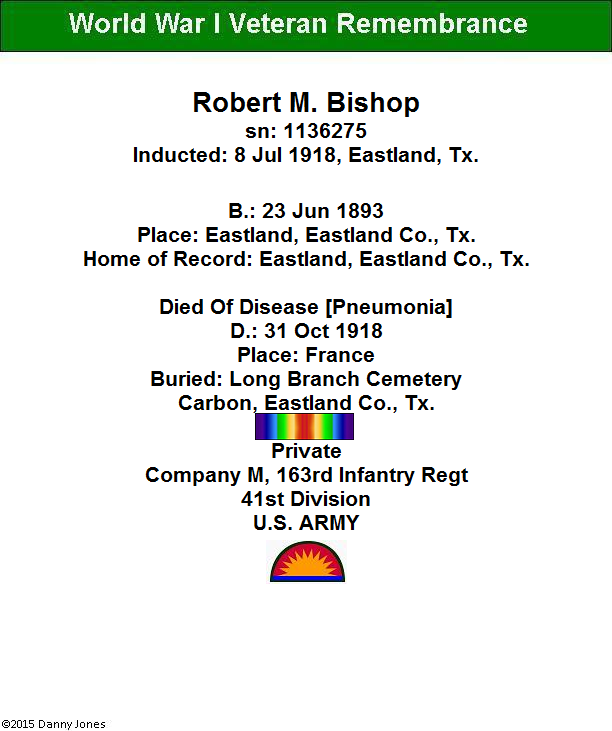
Mr. Robert Monroe Bishop, a single white male living in Carbon, Eastland County, Texas and working as a farmer for himself on J. C. Swift's farm as of June 5, 1917. Robert was of medium height and medium build with brown hair and light brown eyes and a tan complexion. Born in Carbon, Eastland County, Texas on June 23, 1893 to Joseph Alonzo and Louisa M. Bishop, and raised there in Eastland County during his childhood. Robert is listed as living with his parents and a sister in JP4 Eastland County on the 1900 census. Robert 'Bob' is listed as living with his parents and siblings in JP4 Eastland County on the 1910 census. Robert's father is listed as next of kin on his Army record.
Robert was drafted into federal service for the US Army on July 8, 1918 at Eastland, Texas. He was sent to boot camp at Camp MacArthur in Waco. Private Bishop was in Camp MacArthur for training with the Company M 9th Battalion Infantry Replacements 57th Depot Brigade. On August 16, 1918, Robert was assigned to 8th Company August Auto Replacement Draft Camp MacArthur Texas. Soon after this assignment they moved out to Camp Mills New York and then to the port of embarkation in Hoboken New Jersey and boarded the transport ship to France on August 24, 1918 for the eleven day voyage to France. But then, only a few days after reaching France Robert's unit spent time training near Bordeaux France and St. Aignan France with the 1st Depot Division. On September 11, 1918, Private Bishop was attached to Company M 163rd Infantry Regiment 41st Division and was engaged in active operations in the St. Mihiel and Meuse-Argonne offensive. Robert died of pneumonia on October 31, 1918 near Souilly, Meuse, France.
Private Robert M. Bishop was buried in a temporary grave there in France to be later repatriated to America. The Graves Registration Service of the US Army was Robert's new unit. The GRS did an awesome job during and after the battles of WW1. Robert's remains were loaded onto the USAT Wheaton in Antwerp, Belgium on June 19, 1921 and arrived in Hoboken New Jersey on July 2, 1921. Then shipped July 22, 1921 by train to Carbon, Texas arriving July 27, 1921. Robert Bishop was laid to rest in the Long Branch Cemetery, Carbon, Eastland County, Texas. Survived by his parents.


Mr. Reid Boon, a single white male living in Cisco, Eastland County, Texas and working as a tire vulcanizer for himself as of June 5, 1917. Reid was medium height and medium build with brown hair and brown eyes, and probably a tan complexion from all of the outside work. Born in Alvin, Brazoria County, Texas October 3, 1894 to Robert H. and Elizabeth 'Birdie' Boon, and raised there in Brazoria County during his childhood. Reid was living with his parents and siblings in Weatherford, Parker County as reported in the 1900 census. Reid was living with his parents and siblings in JP1 Parker County as reported in the 1910 census. On Reid's Army record his father is listed as next of kin and living in Cisco, Texas.
Reid was drafted into federal service for the US Army on March 29, 1918 at Eastland, Texas. He was sent to boot camp at Camp Travis in San Antonio. March 31, 1918 Reid was in Camp Travis for training with the 27th Company 7th Training Battalion 165th Depot Brigade. On May 29, 1918 Private Boon was assigned to Company K 358th Infantry Regiment in the 90th Infantry Division. Soon after his assignment they moved out to Camp Mills New York and then to the port of embarkation in Hoboken New Jersey and boarded the transport ship to England on June 20, 1918 for the eleven day voyage to England. But then, only a few days after reaching England Reid's company entered France and spent time training near Rouvres France for six weeks at eight hours per day. On August 19, 1918, the division moved to the vicinity of Toul. This move was scarcely completed when the division was ordered to relieve the 1st Division in the line in the Villers-en-Haye sector north of Toul, which was completed on August 24, 1918. The 90th division's St. Mihiel operation began September 12, 1918. Reid was killed in action on the battlefield during the division's St. Mihiel operations on September 12, 1918. His father was notified.
Private Reid Boon was buried in a temporary grave there in France to be later reinterred on August 16, 1922 in the Saint Mihiel↘ American Cemetery at Thiaucourt, France. The Grave Registration Service did an awesome job during and after the battles of WW1. Survived by his parents.


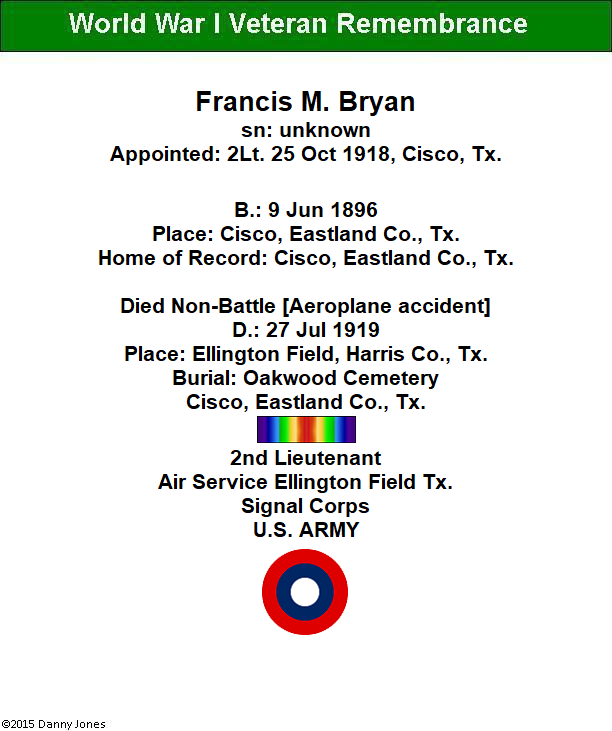
Mr. Francis Minor Bryan, a single white male living in Cisco, Eastland County, Texas and his employment unknown as of July 30, 1917. Francis enlisted and did not register for the draft. Born in Sabanno, Eastland County, Texas June 9, 1895 to Preston B. and Julia O. Bryan and raised in Eastland County. Francis was reported as living with his parents and siblings in JP4 Eastland County, Texas in the 1900 census. Francis was reported as living with his parents and siblings in JP6 Eastland County, Texas in the 1910 census. Francis's Army record lists his father as next of kin and living in Cisco, Texas.
Francis was enlisted into federal service for the US Army on July 30, 1917 at Ft Sam Houston Texas. Recruit Bryan was sent to boot camp at Ft Sam Houston in San Antonio and assigned to 47th Aero Squadron Aviation Section of the Signal Corps to January 30, 1918. Private 1st Class Bryan was assigned to 42nd Aero Squadron Air Section of the Signal Corps to March 22, 1918. Francis was transferred to the School of Military Aeronautics at Ohio State University Columbus Ohio to June 26, 1918. Francis was sent to Aviation Section Ellington Field San Leon School near Houston, Texas to October 25, 1918 when he was honorably discharged to accept a commission. Francis continued his flying and teaching at Ellington Field, Texas.
![[Air Service]](../sealAirService.png "US Army Air Service") 2nd Lieutenant Francis M. Bryan Air Service of the U.S. Army, Ellington Field, Texas pilot instructor in Curtiss JN-4D SC-2647 on July 27, 1919 out of Ellington Field on a routine training mission in the area with Private Will Poncik aboard. The aircraft went into a direct tail spin and crashed in a wooded area two miles southwest of Ellington Field. The Lieutenant died of injuries received in the crash, but the Private survived. Lieutenant Francis Bryan's body was sent to Cisco, Texas where he was laid to rest in the Oakwood Cemetery, Cisco, Eastland County, Texas. Survived by his parents.
2nd Lieutenant Francis M. Bryan Air Service of the U.S. Army, Ellington Field, Texas pilot instructor in Curtiss JN-4D SC-2647 on July 27, 1919 out of Ellington Field on a routine training mission in the area with Private Will Poncik aboard. The aircraft went into a direct tail spin and crashed in a wooded area two miles southwest of Ellington Field. The Lieutenant died of injuries received in the crash, but the Private survived. Lieutenant Francis Bryan's body was sent to Cisco, Texas where he was laid to rest in the Oakwood Cemetery, Cisco, Eastland County, Texas. Survived by his parents.


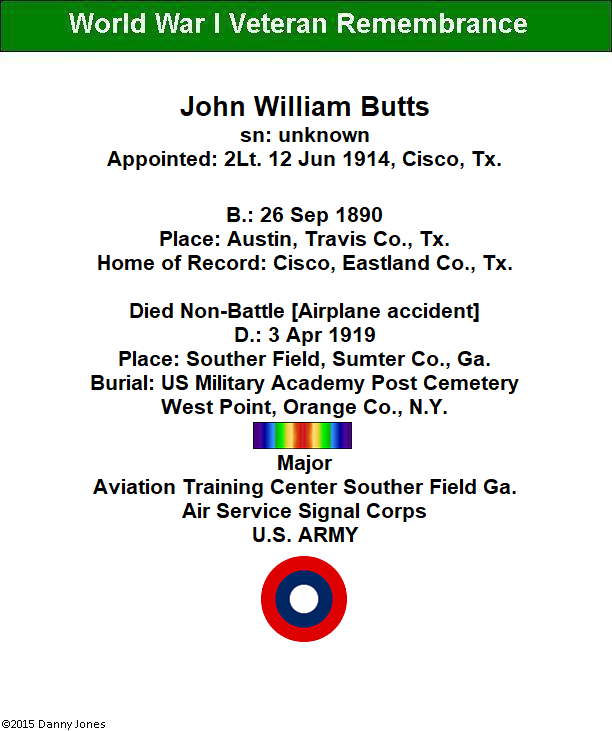
Mr. John William Butts, a married white male living in Cisco, Eastland County, Texas and he was a graduate of the US Military Academy in 1914 and serving as a 2nd Lieutenant Cavalry as of April 6, 1917. John was born in Austin, Travis County, Texas September 26, 1890 to John J. and Bernie B. Butts and raised in Travis County. John was reported as living with his parents and siblings in JP6 Cisco, Eastland County, Texas in the 1900 census. John was reported as living with his parents and siblings in Cisco, Eastland County, Texas in the 1910 census. I found no records of his marriage. John's Army record lists his wife as next of kin and living in Cisco, Texas.
John was appointed a 1st Lieutenant Aviation Section Signal Corps of the US Army on April 6, 1917 at Mineola, New York. John was promoted to Captain on June 2, 1917. Captain Butts served at Dallas, Texas and Call Field, Texas. John was promoted to Major on June 30, 1918. John also served at Washington, D.C. and Souther Field, Georgia. John continued his flying and teaching at Souther Field, Georgia.
Major John W. Butts Air Service of the U.S. Army, Executive Officer Souther Field, Georgia was piloting Curtiss JN-4D (serial number unknown) on 3 April 1919 out of Souther Field, Georgia on a not so routine aerial trip around the area with LTC Frederick T. Dickman commanding officer Souther Field aboard. Upon the approach to land at Souther Field a wing dipped and caused the aircraft to crash killing both officers aboard. Maj Butts' body was sent to West Point, New York where he was laid to rest in the US Military Academy Post Cemetery, West Point, Orange County, New York. Survived by his wife and parents.


Mr. Heber Winter Daniels, a single white male living in Eastland, Eastland County, Texas and working as a farmer for Wiley Harbin 6 miles south of Eastland as of June 5, 1917. Heber was tall and slim with light brown hair and blue eyes, and probably a tan complexion from all of the farm work. Born in Eastland, Eastland County, Texas March 15, 1894 to Julius L. and Nora M. Daniels, and raised there in Eastland County during his childhood. Heber was living with his parents and siblings in JP1 Eastland, Eastland County as reported in the 1900 census. Heber was living with his parents and siblings in JP1 Parker County as reported in the 1910 census. On Heber's Army record his father is listed as next of kin and living in Eastland, Texas.
Heber was drafted into federal service for the US Army on April 27, 1918 at Eastland, Texas. He was sent to boot camp at Camp Travis in San Antonio. Heber was in Camp Travis for training with the 25th Company 7th Training Battalion 165th Depot Brigade. On May 13, 1918 Private Daniels was assigned to Company F 359th Infantry Regiment in the 90th Infantry Division. Soon after his assignment they moved out to Camp Mills New York and then to the port of embarkation in Hoboken New Jersey and boarded the transport ship to England on June 20, 1918 for the eleven day voyage to England. But then, only a few days after reaching England Heber's company entered France and spent time training near Rouvres France for six weeks at eight hours per day. On August 19, 1918, the division moved to the vicinity of Toul. This move was scarcely completed when the division was ordered to relieve the 1st Division in the line in the Villers-en-Haye sector north of Toul, which was completed on August 24, 1918. Heber was promoted to Private 1st Class on September 3, 1918. The 90th division's St. Mihiel operation began September 12, 1918. Heber was killed in action on the battlefield during the division's St. Mihiel operations on September 12, 1918. His father was notified.
Private 1st Class Heber W. Daniels was buried in a temporary grave there in France to be later repatriated to America. The Graves Registration Service of the US Army was Heber's new unit. The GRS did an awesome job during and after the battles of WW1. Heber's remains were loaded onto the USAT Cambrai in Antwerp, Belgium on May 23, 1921 and arrived in Hoboken New Jersey on June 6, 1921. Then shipped June 17, 1921 by train to Eastland, Texas arriving June 20, 1921. Heber Daniels was laid to rest in the Eastland City Cemetery, Eastland, Eastland County, Texas. Survived by his parents.


Mr. Lewis Alexander Dulin, a single white male living in Eastland, Eastland County, Texas and working as a farm laborer for J O. Lewis at Proffitt, Texas as of June 5, 1917. Lewis was medium height and medium build with light brown hair and light blue eyes and a tan complexion. Born in Eastland, Eastland County, Texas on January 30, 1896 to Emory D. and Maggie L. Dulin, and was raised in Eastland County, Texas. Lewis was reported as living with his parents and siblings in JP1 Eastland County, Texas in the 1900 census and in the 1910 census. Lewis's father, Emory D. Dulin of Eastland, Texas, is listed as next of kin on his Army record.
Lewis was enlisted into federal service for the US Army on May 20, 1918 at Camp Bowie, Texas. Recruit Dulin was sent to boot camp at Camp Bowie in Fort Worth. Private Dulin was assigned to Company E 141st Infantry Regiment 36th Division at Camp Bowie in Fort Worth. The first units of the 36th Division arrived in France May 31, 1918 and the last on August 14, 1918. Private Dulin's unit moved to Camp Mills, New York then to the port of embarkation in Brooklyn, New York and boarded the transport ship to France on July 26, 1918 for the eleven day voyage to France. The 36th Division was stationed at Bar-sur-Aube until September 26, 1918, conducting training with the French Army. The division's Meuse-Argonne operations began October 7, 1918, and it was between Somme-Py and Givry during this battle that Lewis was killed in action October 8, 1918, and buried near the battlefield. His father was notified.
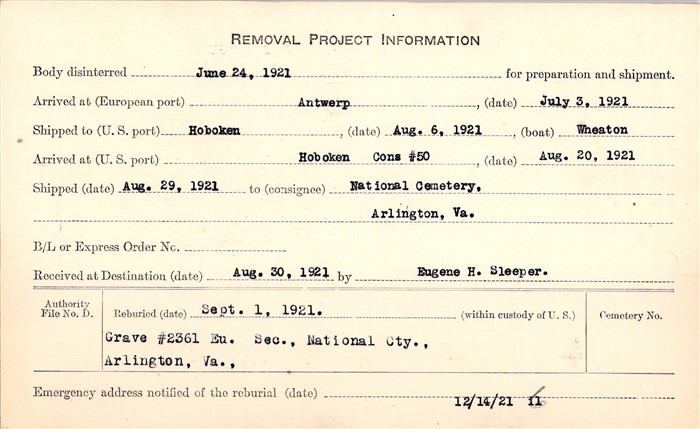
Private Lewis A. Dulin was buried in a temporary grave there in France to be later repatriated to America. The Graves Registration Service of the US Army was Lewis's new unit. The GRS did an awesome job during and after the battles of WW1. Lewis's remains were loaded onto the USAT Wheaton in Antwerp, Belgium and departed on August 6, 1921 and arrived in Hoboken New Jersey on August 20, 1921. Then shipped August 29, 1921 by train to Arlington, Virginia arriving August 30, 1921. Lewis Dulin was laid to rest in the Arlington National Cemetery at Arlington, Arlington County, Virginia on September 1, 1921. Survived by his parents. On April 3, 1919 Private Lewis Dulin was awarded posthumously the French Croix de Guerre with silver star for his courage in battle.


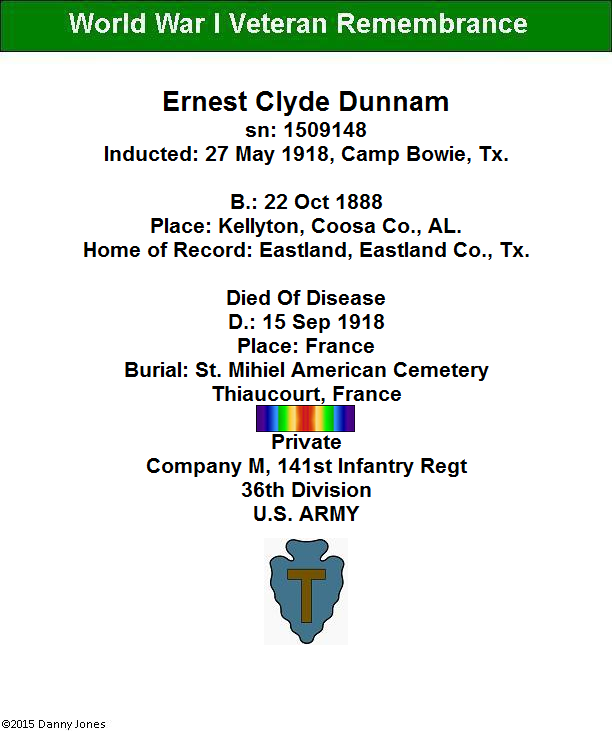
Mr. Ernest Clyde Dunnam, a single white male living in Eastland, Eastland County, Texas and working as a farmer for F. P. Dunnam 6 miles south of Eastland as of June 5, 1917. Ernest was a medium height and medium build man with dark brown hair and brown eyes, and probably a very tan complexion from all of the farm work. Born at Kellyton, Coosa County, Alabama on October 22, 1888 to Francis P. and Mary C. Dunnam, and was raised there in Coosa County. Ernest and his parents and siblings are reported in the 1900 census as being in JP3 Holland, Bell County, Texas, and were not found on the 1910 census. Ernest's father, Francis P. Dunnam at Eastland, Texas, is listed as next of kin on his Army record.
Ernest was drafted into federal service for the US Army on May 27, 1918 at Camp Bowie, Tarrant County, Texas. Recruit Dunnam was sent to boot camp at Camp Bowie in Fort Worth he was assigned to Company M 141st Infantry Regiment 36th Division. The first units of the 36th Division arrived in France May 31, 1918 and the last on August 14, 1918. Private Dunnam's unit moved to Camp Mills, New York then to the port of embarkation in Brooklyn, New York and boarded the transport ship to France on July 26, 1918 for the eleven day voyage to France. The 36th Division was stationed at Bar-sur-Aube until September 26, 1918, conducting training with the French Army. Ernest got sick at this training station with the influenza and died of pneumonia on September 15, 1918. His father was notified in Eastland, Texas.
Private Ernest C. Dunnam was buried in a temporary grave there in France to be later reinterred on August 17, 1922 at the Saint Mihiel↘ American Cemetery in Thiaucourt, Lorraine, France. The Graves Registration Service of the US Army did an awesome job during and after the battles of WW1. Survived by his parents.


Mr. Charles Edward Ferguson, a single white male living in Nimrod, Eastland County, Texas and working as a farm laborer as of June 5, 1917. Charles was of tall and slender build with brown hair and brown eyes and a tan complexion. He listed as an exception on the draft card that he lost one eye. Born in Nimrod, Eastland County, Texas on January 1, 1895 to Thomas J. and Cynthia A. Ferguson, and raised there in Eastland County during his childhood. Charles is listed as living with his parents and a brother in JP4 Eastland County on the 1900 census. Charles is listed as living with his parents and brother in Nimrod, Eastland County on the 1910 census. Charles's mother died in 1912 and his father died in 1915. Charles's brother, William T. Ferguson of Nimrod, Texas, is listed as next of kin on his Army record.
Charles was drafted into federal service for the US Army on July 8, 1918 at Eastland, Texas. He was sent to boot camp at Camp MacArthur in Waco. Private Ferguson was in Camp MacArthur for training with the Company L then Company M 9th Battalion Infantry Replacements 57th Depot Brigade. On August 16, 1918, Charles was assigned to 8th Company August Auto Replacement Draft Camp MacArthur Texas. Soon after this assignment they moved out to Camp Mills New York and then to the port of embarkation in Hoboken New Jersey and boarded the transport ship to France on August 24, 1918 for the eleven day voyage to France. But then, only a few days after reaching France Charles's unit spent time training near Bordeaux France and St. Aignan France with the 1st Depot Division. On September 11, 1918, Private Ferguson was attached to Company M 163rd Infantry Regiment 41st Division and was engaged in active operations in the St. Mihiel and Meuse-Argonne offensive. Charles died of typhoid fever on November 14, 1918 near Souilly, Meuse, France.
Private Charles E. Ferguson was buried in a temporary grave there in France to be later reinterred on October 18, 1921 at the Meuse-Argonne↘ American Cemetery in Romagne-sous-Montfaucon, Lorraine, France. The Graves Registration Service of the US Army did an awesome job during and after the battles of WW1. Survived by his brother.


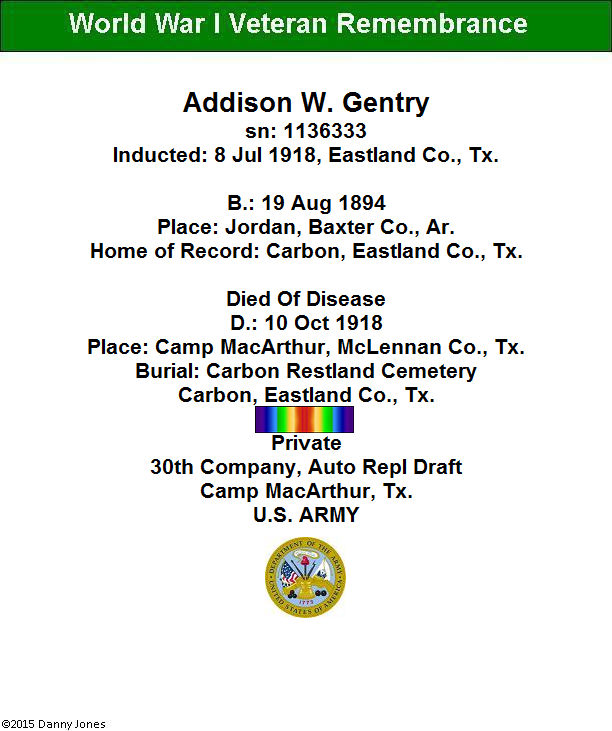
Mr. Addison Ware Gentry, a single white male living in Carbon, Eastland County, Texas and working as a farmer for himself as of June 5, 1917. Addison was of tall and slender build with black hair and blue eyes and a tan complexion. Born in Sheridan, Grant County, Arkansas on August 19, 1894 to William Aaron and Rosaltha Alice Gentry, and raised there in Grant County, Arkansas during his childhood. Addison is listed as living with his parents and siblings in Sheridan, Grant County, Arkansas on the 1900 census. Addison (Eddison) is listed as living with his parents and siblings in JP5 Eastland County, Texas on the 1910 census. Addison's father, William A. Gentry of Carbon, Texas, is listed as next of kin on his Army record.
Addison was drafted into federal service for the US Army on July 8, 1918 at Eastland, Texas. He was sent to boot camp at Camp MacArthur in Waco. Private Gentry was in Camp MacArthur for training with the Company K 9th Battalion Infantry Replacements 57th Depot Brigade. On September 17, 1918, Addison was assigned to 30th Company September Auto Replacement Draft Camp MacArthur Texas. Soon after this assignment they moved out to Camp Mills New York and then to the port of embarkation in Hoboken New Jersey and boarded the transport ship to France on September 29, 1918 for the eleven day voyage to France. But then, only a few days before reaching France Addison got sick on the boat. Addison died of pneumonia on October 10, 1918 at Lambezellec, Finistere, France.
Private Addison W. Gentry was buried in a temporary grave there in France to be later repatriated to America. The Graves Registration Service of the US Army was Addison's new unit. The GRS did an awesome job during and after the battles of WW1. Addison's remains were loaded onto the USAT Mercury in Brest, France and departed on June 6, 1920 and arrived in Hoboken New Jersey on June 30, 1920. Then shipped July 14, 1920 by train to Little Rock, Arkansas arriving July 17, 1920. Then shipped by train to Carbon, Texas. Addison Gentry was laid to rest in the Carbon Restland Cemetery, Carbon, Eastland County, Texas. Survived by his parents.


Mr. Roy C. Graves, a single white male living in Cisco, Eastland County, Texas and working as a ranch foreman for C. M. Cauble as of June 5, 1917. Roy was medium height and medium build with black hair and gray eyes, and probably a very tan complexion from all of the ranch work. Born in Stephenville, Erath County, Texas May 12, 1895 to Ezra E. and Lillie Mae Graves, and raised there in Erath County during his childhood. Roy was reported living with his parents and siblings in JP6 Eastland County in the 1900 census. On Roy's Army record his mother is listed as next of kin and living in Cisco, Texas.
Roy was drafted into federal service for the US Army on September 21, 1917 at Eastland, Texas. He was sent to boot camp at Camp Travis in San Antonio. Roy was in Camp Travis for training with the 165th Depot Brigade. On October 13, 1917, Private Graves was assigned to Company F 360th Infantry Regiment in the 90th Infantry Division. Roy was promoted to Corporal on March 1, 1918. His Company F 360th Infantry Regiment moved out to Camp Mills New York and then to the port of embarkation in Hoboken New Jersey and boarded the transport ship to England on June 14, 1918 for the eleven day voyage to England. But then, only a few days after reaching England Roy's company entered France and spent time training near Rouvres France for six weeks at eight hours per day. On August 19, 1918, the division moved to the vicinity of Toul. This move was scarcely completed when the division was ordered to relieve the 1st Division in the line in the Villers-en-Haye sector north of Toul, which was completed on August 24, 1918. The 90th division's St. Mihiel operation was September 12-16, 1918. The division remained in line in the Puvenelle sector until October 10, 1918. Roy was wounded in action on the battlefield during the division's Puvenelle operations. Corporal Graves died of wounds on October 4, 1918. His mother was notified.
Corporal Roy C. Graves was buried in a temporary grave there in France to be later repatriated to America. The Graves Registration Service of the US Army was Roy's new unit. The GRS did an awesome job during and after the battles of WW1. Roy's remains were loaded onto the USAT Cambrai in Antwerp, Belgium and departed on May 23, 1921 and arrived in Hoboken New Jersey on June 6, 1921. Then shipped June 23, 1921 by train to Cisco, Texas arriving June 28, 1921. Roy Graves was laid to rest in the Oakwood Cemetery, Cisco, Eastland County, Texas. Survived by his parents.


Mr. Leslie Monroe Groves, a single white male living in Carbon, Eastland County, Texas and working as a farmer for himself as of June 5, 1917. Leslie was tall and slim build with light color hair and blue eyes, and probably a very tan complexion from all of the farm work. Born in Carbon, Eastland County, Texas February 14, 1895 to William H. and Sudie P. Groves, and raised there in Eastland County during his childhood. Leslie was reported living with his parents and a brother in JP5 Eastland County in the 1900 census. Leslie was reported living with his parents and siblings in Carbon, Eastland County in the 1910 census. I did not find a record of Leslie's marriage. On Leslie's Army record his wife, Mrs. Mattie Groves of Carbon, Texas, is listed as next of kin.
Leslie was drafted into federal service for the US Army on July 22, 1918 at Eastland, Texas. He was sent to boot camp at Camp Travis in San Antonio. Leslie was in Camp Travis for training with the 165th Depot Brigade. About August 22, 1918, Private Groves was assigned to 1st Company 7th Provisional Ordnance Detachment of the Ordnance Corps. His Company moved out to Camp Mills New York and then to the port of embarkation in Hoboken New Jersey and boarded the transport ship to England on October 6, 1918 for the eleven day voyage to England. But then, just after reaching England Leslie died of pneumonia on October 18, 1918. His wife was notified.
Private Leslie M. Groves was buried in a temporary grave there in England to be later repatriated to America. The Graves Registration Service of the US Army was Leslie's new unit. The GRS did an awesome job during and after the battles of WW1. Leslie's remains were loaded onto the USAT Antigone in Liverpool, England and departed on September 18, 1920 and arrived in Hoboken New Jersey on September 29, 1920. Then shipped October 14, 1920 by train to Carbon, Texas arriving October 19, 1920. Leslie Groves was laid to rest in the Eastland City Cemetery, Eastland, Eastland County, Texas. Survived by his parents.


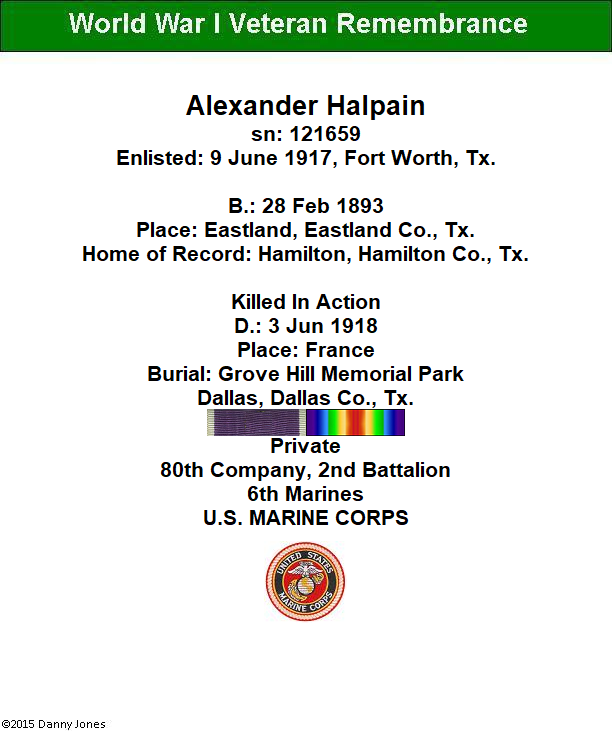
Mr. Alexander S. Halpain, a single white male living in Hamilton, Hamilton County, Texas and was registering in Fort Worth as of June 9, 1917, because he had just enlisted in the Marines and was leaving that very night for training camp at Port Royal, South Carolina. Alexander was tall and stout build with dark brown hair and brown eyes, and probably a very tan complexion. Born in Eastland, Eastland County, Texas February 28, 1893 to William M. and Nancy L. Halpain, and raised there in Eastland County during his childhood. Alexander was reported living with his parents and siblings in JP1 Hamilton County in the 1900 census. Alexander's mother died in 1904. Alexander was reported living with his father and two sisters in Hamilton, Hamilton County in the 1910 census. On Alexander's Marine Corps record his father is listed as next of kin.
Alexander was enlisted into federal service for the US Marine Corps on June 9, 1917 at Fort Worth, Texas. He was sent to boot camp at Port Royal, South Carolina. Alexander was transferred to 80th Company Quantico, Virginia for training with the 2nd Battalion 6th Marine Regiment. His Company moved out to the port of embarkation in Hoboken New Jersey and boarded the transport ship to France on February 12, 1918 for the eleven day voyage to France. The Marines were combined with the Army to form the 2nd Division, but kept their Marine Corps unit designations. After a period of training with the Army 2nd Division headquarters at Bourmont, Haute-Marne, from February 26, 1918, to March 16, 1918, the 2nd Division entered the Verdun and Toul sectors with headquarters at Sommedieu. Constant patrolling and several enemy raids repulsed. On May 31st moved in to the Chateau-Thierry sector, passing from the 7th A. C. French to the 21st A. C. French as reserve. Went forward about June 1, 1918, to meet a strong enemy attack which had developed on the line west of Chateau-Thierry. The attack of June 3d and 4th was halted June 4th on the line west of Chateau-Thierry. Private Halpain was killed in action during the attack of June 3, 1918. His father was notified.
![[Marines]](../sealMarines.png) Private Alexander S. Halpain was buried in a temporary grave there in France to be later repatriated to America. The Graves Registration Service of the US Army was Alexander's new unit. The GRS did an awesome job during and after the battles of WW1. Alexander's remains were loaded onto the USAT Somme in Antwerp, Belgium and departed on June 23, 1921 and arrived in Hoboken New Jersey on July 5, 1921. Then shipped July 29, 1921 by train to Dallas, Texas arriving August 2, 1921. Alexander Halpain was laid to rest in the Grove Hill Memorial Park Cemetery, Dallas, Dallas County, Texas. Survived by his father.
Private Alexander S. Halpain was buried in a temporary grave there in France to be later repatriated to America. The Graves Registration Service of the US Army was Alexander's new unit. The GRS did an awesome job during and after the battles of WW1. Alexander's remains were loaded onto the USAT Somme in Antwerp, Belgium and departed on June 23, 1921 and arrived in Hoboken New Jersey on July 5, 1921. Then shipped July 29, 1921 by train to Dallas, Texas arriving August 2, 1921. Alexander Halpain was laid to rest in the Grove Hill Memorial Park Cemetery, Dallas, Dallas County, Texas. Survived by his father.


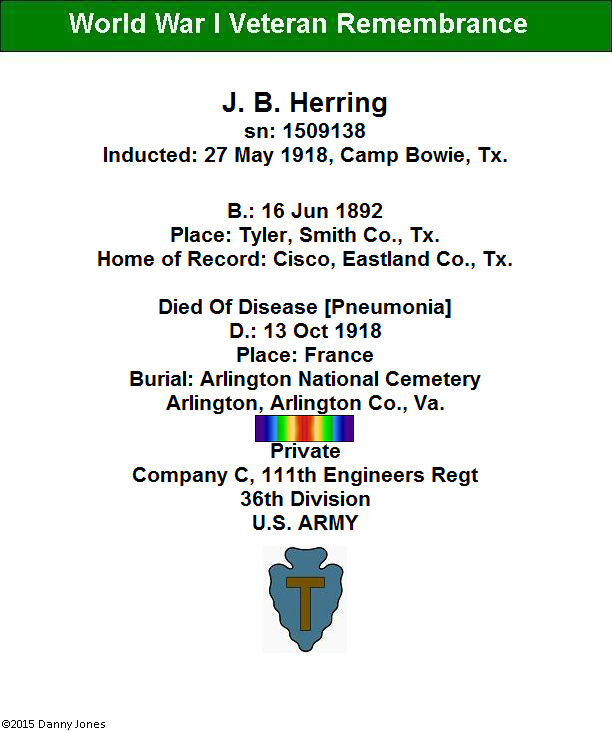
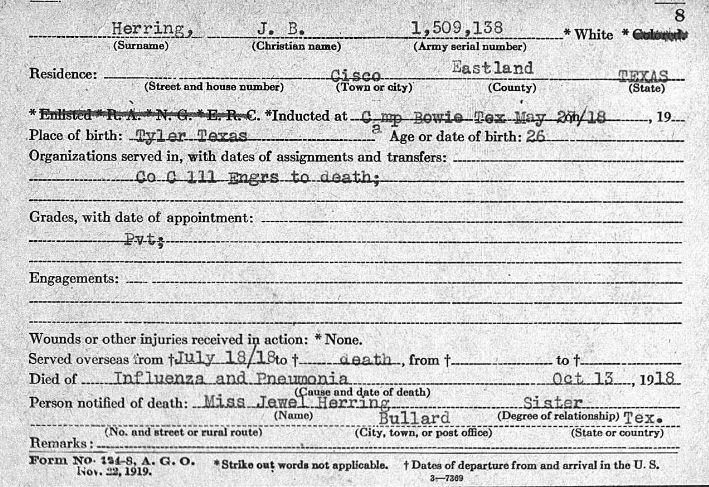
Mr. Jesse B. Herring, a married white male living in Cisco, Eastland County, Texas and he was working as a cook for G. W. Travis in Cisco, Texas as of June 5, 1917. Jesse B. was medium height and medium build with brown hair and grey eyes and probably a normal complexion. Born in Tyler, Smith County, Texas on June 16, 1892 to Robert and Ella M. Herring, and was raised in Smith County, Texas. Jesse B. (Jb) was reported living with his parents and siblings in JP5 Smith County, Texas on the 1900 census. Jesse B.'s mother died in 1905. Jesse B. was not found on the 1910 census. No record found on his marriage as it was stated on his draft card. His sister, Miss Jewel Herring of Bullard, Texas, is listed as next of kin on his Army record.
Jesse B. Herring was drafted into federal service for the US Army on May 27, 1918 at Camp Bowie, Texas. Recruit Herring was sent to boot camp at Camp Bowie in Fort Worth for training. Private Herring was given assignment to Company C 111th Engineer Regiment 36th Division at Camp Bowie. The first units of the 36th Division arrived in France May 31, 1918 and the last on August 14, 1918. Private Herring's unit moved to the port of embarkation in Hoboken New Jersey and boarded the transport ship to France on July 18, 1918 for the eleven day voyage to France. The 36th division was stationed at Bar-sur-Aube until September 26, 1918, conducting training with the French Army. On September 27th the division left for the Champagne section, detraining at Epernay and vicinity. Commencing Oct. 6th, the division took an active part in the operations of the 4th French Army, advancing a distance of twenty-one kilometers to the Aisne river, it was during this offensive that Jesse got sick, probably influenza, and died from pneumonia on October 13, 1918, in a field hospital. His sister was notified.
Private Jesse B. Herring was buried in a temporary grave there in France to be later repatriated to America. The Graves Registration Service of the US Army was Jesse's new unit. The GRS did an awesome job during and after the battles of WW1. Jesse's remains were loaded onto the USAT Crook in Antwerp, Belgium and departed on December 28, 1921 and arrived in Hoboken New Jersey on January 14, 1922. Then shipped February 1, 1922 by train to Arlington, Virginia arriving February 3, 1922. Jesse B. Herring was laid to rest in the Arlington National Cemetery at Arlington, Arlington County, Virginia. Survived by his sister.




Mr. Anson Homer James, a single white male living in Knox City, Knox County Texas and working as a R.R. agent & operator for K.C.M.&O. R.R. Co. in Knox City, Texas as of June 5, 1917. Anson was of medium height and medium build with brown hair and brown eyes, and probably a very tan complextion from all of the outside work. Born in Desdemona, Eastland County, Texas May 26, 1895 to William and Ora James and raised there in Eastland and Erath Counties. Homer was found living with his parents and siblings in JP7 Erath County, Texas on the 1900 census. Homer A. was found living with his parents and siblings in Stamford, Jones County, Texas on the 1910 census. Anson's friend, J. R. Edgar of Crowell, Texas, is listed as next of kin on his Army record.
Anson was drafted into federal service for the US Army on September 19, 1917 at Benjamin, Texas. Recruit James was sent to boot camp at Camp Travis in San Antonio. Private James was in Camp Travis for training with the Infirmmary No.3 Medical Department 165th Depot Brigade. Private Anson H. James was there almost seven months helping the sick soldiers at Camp Travis when he died suddenly in the base hospital on April 6, 1918, cause unknown. His friend was notified in Crowell, Texas.
Private Anson H. James was laid to rest in the Rose Hill Cemetery at Ardmore, Carter County, Oklahoma on April 8, 1918. Survived by his parents.


Mr. Alvin Mauney, a single white male living in Grassland, Lynn County, Texas and working at well drilling for J. L. Williams at Grassland, Texas as of June 5, 1917. Alvin was short and medium build with light brown hair and light blue eyes with a tan complexion. Born in Gorman, Eastland County, Texas on December 8, 1895 to John M. and Annie 'Vick' Mauney, and was raised in Eastland County, Texas. Alvin was reported as living with his parents and siblings in JP5 Eastland County, Texas in the 1900 census. Alvin was reported as living with his parents and siblings in JP5 Comanche County, Texas in the 1910 census. Alvin's mother of Gorman, Texas is listed as next of kin on his Army record.
Alvin was enlisted into service for the Texas National Guard on July 4, 1917 at Post, Garza County, Texas. Recruit Mauney was sent to boot camp at Camp Bowie in Fort Worth. Alvin was given assignment for training to the Supply Company 7th Infantry Texas National Guard. On September 9, 1917, Alvin was given assignment for training to the Company C 7th Infantry Texas National Guard. On October 15, 1917, Alvin was assigned to the Company G 142nd Infantry Regiment 36th Division of the US Army at Camp Bowie in Fort Worth. Private Mauney was promoted to Private 1st Class on November 1, 1917. The first units of the 36th Division arrived in France May 31, 1918 and the last on August 14, 1918. Private Mauney's unit moved to Camp Mills, New York then to the port of embarkation in Hoboken New Jersey and boarded the transport ship to France on July 18, 1918 for the eleven day voyage to France. The 36th division was stationed at Bar-sur-Aube until September 26, 1918, conducting training with the French Army. PFC Mauney was promoted to Corporal on August 15, 1918. The division's Meuse-Argonne operations began October 7, 1918, and it was between Somme-Py and Givry during this battle that Alvin was killed in action October 8, 1918, and buried near the battlefield. His mother was notified.
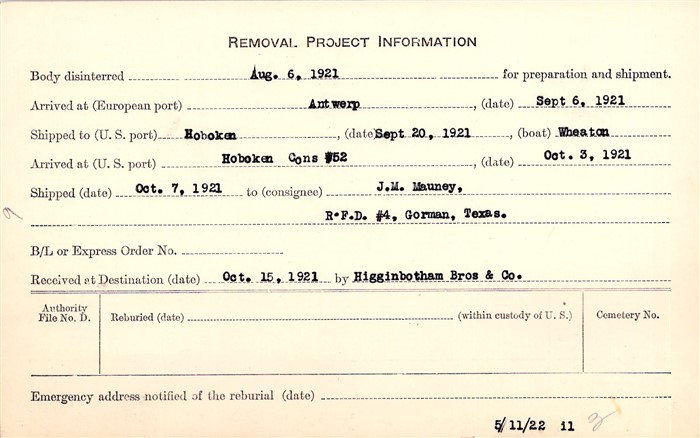
Corporal Alvin Mauney was buried in a temporary grave there in France to be later repatriated to America. The Graves Registration Service of the US Army was Alvin's new unit. The GRS did an awesome job during and after the battles of WW1. Alvin's remains were loaded onto the USAT Wheaton in Antwerp, Belgium and departed on September 20, 1921 and arrived in Hoboken New Jersey on October 3, 1921. Then shipped October 7, 1921 by train to Gorman, Texas arriving October 15, 1921. Alvin Mauney was laid to rest in the Gorman Cemetery, Gorman, Eastland County, Texas. Survived by his parents. On April 4, 1919 Corporal Alvin Mauney was awarded posthumously the French Croix de Guerre with silver star for his courage in battle.


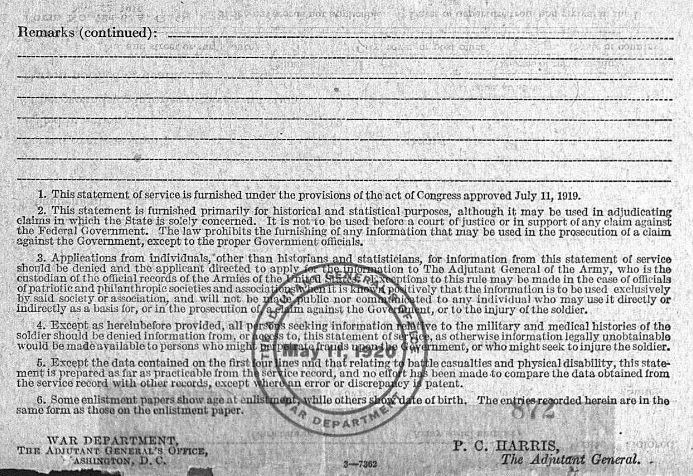

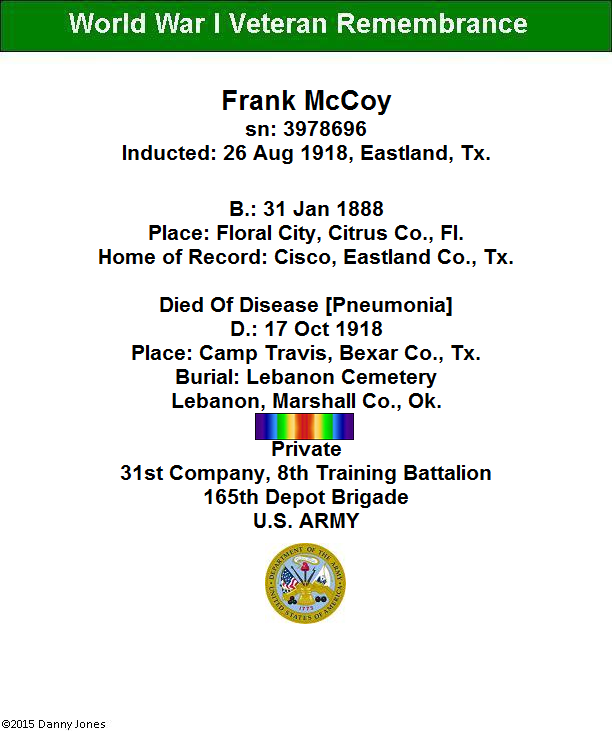
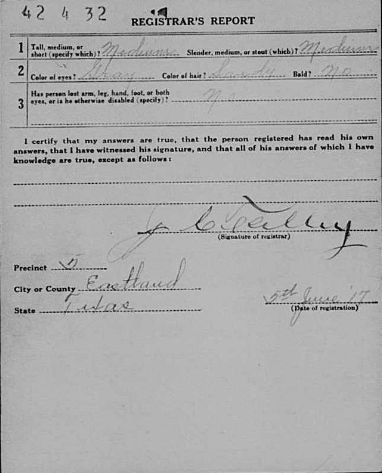
Mr. Frank McCoy, a single white male living in Cisco, Eastland County, Texas and working as a farmer for W. A. Gilmore two miles south of Cisco as of June 5, 1917. Frank was of medium height and medium build with sandy hair and gray eyes, and probably a very tan complextion from all of the farm work. Born in Floral City, Citrus County, Florida on January 31, 1888 to Marcus L. and Almelda Wilda McCoy and raised there in Citrus County. Frank was found living with his parents and siblings in JP4 Eastland County, Texas on the 1900 census. Frank's father died in 1910. Frank M. was found living with his uncle, William S. Kitchens, in Ravia Ward 3, Johnston County, Oklahoma on the 1910 census. Frank's mother, Wilda McCoy of McMillan, Oklahoma, is listed as next of kin on his Army record.
Frank was drafted into federal service for the US Army on August 26, 1918 at Eastland, Texas. Recruit McCoy was sent to boot camp at Camp Travis in San Antonio. Private McCoy was in Camp Travis for training with the 31st Company 8th Training Battalion 165th Depot Brigade. Frank was there almost two months training for the infantry at Camp Travis when he got sick with the influenza and died of pneumonia in the base hospital on October 17, 1918. His mother was notified in Oklahoma.
Private Frank McCoy was laid to rest in the Lebanon Cemetery at Lebanon, Marshall County, Oklahoma on October 19, 1918. Survived by his mother.



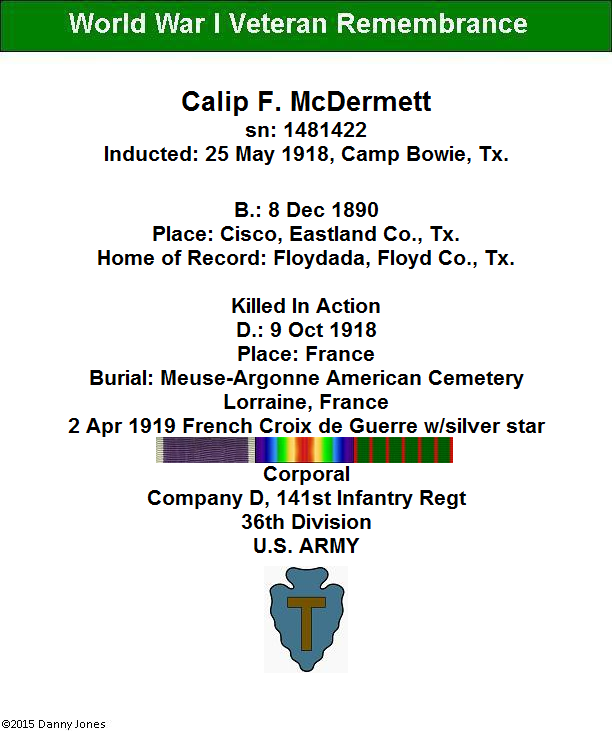
Mr. Calip F. McDermett, a single white male living in Floydata, Floyd County, Texas and working as a ranch hand for John Whitaker in Horse Creek, Wyoming as of June 5, 1917. Calip was of medium height and medium build with black hair and blue eyes and a very tan complexion from all of the ranch work. Calip registered for the draft in Laramie, Wyoming while working there. Calip was born in Cisco, Eastland County, Texas on December 8, 1890 to Frank J. and Lou T. McDermett, and was raised in Eastland County, Texas. Calip 'Caleb' was reported as living with his parents and siblings in JP6 Eastland County, Texas in the 1900 census. Calip's mother died in 1901. Calip was not found in the 1910 census. No record was found of Calip's marriage. Calip's wife, Mrs. Myrtle McDermett of Floydata, Texas, is listed as next of kin on his Army record.
Calip was drafted into federal service for the US Army on May 25, 1918 at Camp Bowie, Texas. Recruit McDermett was sent to boot camp at Camp Bowie in Fort Worth. Calip was assigned to the Company D 141st Infantry Regiment 36th Division of the US Army at Camp Bowie in Fort Worth. The first units of the 36th Division arrived in France May 31, 1918 and the last on August 14, 1918. Private McDermett's unit moved to Camp Mills, New York then to the port of embarkation in Hoboken New Jersey and boarded the transport ship to France on July 26, 1918 for the eleven day voyage to France. The 36th division was stationed at Bar-sur-Aube until September 26, 1918, conducting training with the French Army. PFC McDermett was promoted to Corporal on August 15, 1918. Private McDermett was promoted to Corporal on October 6, 1918. The division's Meuse-Argonne operations began October 7, 1918, and it was between Somme-Py and Givry during this battle that Calip was killed in action October 9, 1918, and buried near the battlefield. His wife was notified.
Corporal Calip F. McDermett was buried in a temporary grave there in France to be later reinterred on October 15, 1921 in the Meuse-Argonne↘ American Cemetery at Lorraine, France. The Graves Registration Service of the US Army was Calip's new unit. The GRS did an awesome job during and after the battles of WW1. Survived by his father. On April 2, 1919 Corporal Calip McDermett was awarded posthumously the French Croix de Guerre with silver star for his courage in battle.


Mr. Henry O'Brien McGraw, a single white male living in Ranger, Eastland County, Texas and working a farm for himself in Eastland County as of June 5, 1917. Henry was of medium height and a medium build with black hair and brown eyes, and probably a very tan complexion from all of the farm work. He was unable to sign his draft card and only made a mark thereon. Born in Waco, McLennan County, Texas June 22, 1888 to George T. and Julia A. McGraw, and he was raised there in McLennan County. Henry's father died in 1899. Henry 'Obrien' was reported living with his mother and siblings in Ranger, Eastland County, Texas in the 1900 census. In the 1910 census, Henry 'Bryan' is reported as living with his mother, Annie, and three brothers in JP2 Eastland County. Henry's Army record lists his mother, Annie McGraw, as next of kin and living in Ranger, Texas.
Henry was drafted into federal service for the US Army on July 22, 1918 at Eastland, Texas. Recruit McGraw was sent to boot camp at Camp Travis in San Antonio on July 23, 1918. Private McGraw was in Camp Travis for training with the 165th Depot Brigade. On or about August 20, 1918 Henry was assigned to Company 1 Casual Regiment at Camp Wheeler, Georgia. On or about September 2, 1918 Private McGraw was assigned to Company B 124th Infantry Regiment 31st Infantry Division. Two weeks later, they moved out to Camp Mills, New York. Henry got sick, probably the influenza and he died of pneumonia on October 17, 1918. His mother was notified.
Private Henry O. McGraw's body was shipped by train to Ranger, Texas. Henry was laid to rest in the Cross Roads Cemetery, Ranger, Eastland County, Texas. Survived by his mother.


Mr. James Lee Miller, a single white male living in Archer City, Archer County, Texas and working as a farmer for W. L. Andrews as of June 5, 1917. James was of medium height and medium build with light color hair and gray eyes, and probably a very tan complexion from all of the farm work. Born in Eastland, Eastland County, Texas on March 29, 1891 to James P. and Emma Miller and he was raised in Eastland County, Texas. He was reported living with his parents and siblings in JP1 Eastland, Eastland County, Texas in both the 1900 and 1910 censuses. James's father of Eastland, Texas is listed as next of kin on his Army record.
James was drafted into federal service for the US Army on October 7, 1917 at Archer City, Texas. Recruit Miller was sent to boot camp at Camp Travis in San Antonio. Private Miller was in Camp Travis for training with the 29th Company 8th Training Battalion 165th Depot Brigade. He was there until October 22, 1917 then transferred to Camp Bowie in Fort Worth and was assigned to the Battery C 133rd Field Artillery Regiment of the 36th Infantry Division. The first units of the 36th Division arrived in France May 31, 1918 and the last on August 14, 1918. Private Miller's unit moved to the port of embarkation in Hoboken New Jersey and boarded the transport ship to France on July 31, 1918 for the eleven day voyage to France. The 36th division was stationed at Bar-sur-Aube until September 26, at which time it moved by rail to the area between Epernay and Chalons and established headquarters at Pocancy, Department of the Maine. Here it remained 10 days, as a reserve of the French group of armies of the center, attached to the French Fifth Army for purposes of supply.
To the north, only a short distance, the Meuse-Argonne operation was under way. The American attack between the Argonne and the Meuse was being aided by the French Fourth Army in the Champagne just to the west. In the latter sector the enemy stubbornly resisted every attack, and on October 3 the 36th Division was transferred to the French Fourth Army, with which the American 2nd Division was already serving. On the night of October 4th units of the division began moving from the Pocancy area to the vicinity of Suippes and Somme-Suippes. Meuse-Argonne operation, October 7-26, 1918. The division was then assembled in the Suippes-Somme-Suippes area and from this point moved to the Triaucourt area and established headquarters at Conde-en-Barrois. Here it remained until the signing of the armistice as a unit of the American First Army. On November 18th the troops departed, by marching, for the 16th training area surrounding Tonnerre, arriving in billets in the Tonnerre area November 28th. Private Miller died of meningitis on December 8, 1918. His father was notified.
Private James L. Miller was buried in a temporary grave there in France to be later repatriated to America. The Graves Registration Service of the US Army was James's new unit. The GRS did an awesome job during and after the battles of WW1. James's remains were loaded onto the USAT Antigone in Brest, France and departed on July 22, 1920 and arrived in Hoboken New Jersey on August 7, 1920. Then shipped August 25, 1920 by train to Eastland, Texas arriving August 29, 1920. James Miller was laid to rest in the Eastland City Cemetery, Eastland, Eastland County, Texas. Survived by his parents.


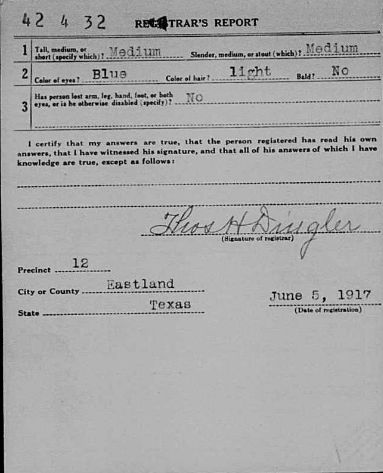
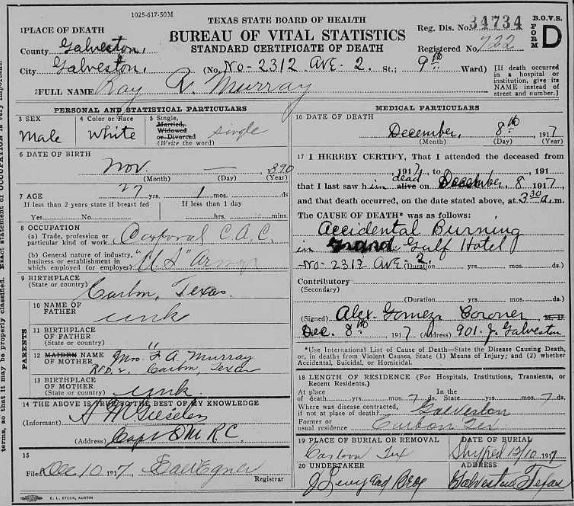
Mr. Ray Robert Murray, a single white male living in Carbon, Eastland County, Texas and working as a farmer for himself near Carbon as of June 5, 1917. Ray was of medium height and medium build with light color hair and blue eyes, and probably a very tan complextion from all of the farm work. On his draft card he stated that he had three years of previous military service with the US Coast Artillery Corps from June 24, 1912 until June 23, 1915. Born in Carbon, Eastland County, Texas on October 19, 1893 to Samuel A. and Missouri Murray and raised there in Eastland County. Ray was found living with his parents and siblings in JP5 Eastland County, Texas on the 1900 census. Ray 'Robert R' was found living with his parents and siblings in JP5 Eastland County, Texas on the 1910 census. It is reported that Ray married Miss Letha Elnora Adams, but no records of the marriage were found. Ray's mother, Mrs. S. A. Murray of Carbon, Texas, is listed as next of kin on his Army record.
Ray was enlisted into federal service for the US Army on July 30, 1917 at Ft Sam Houston, Texas. Recruit Murray was sent to 2nd Company Coast Artillery Corps Galveston Texas. Private Murray was assigned to the Battery D Trench Mortar Battalion Coast Artillery Corps Galveston Texas at date unknown. Private Murray was promoted to Corporal, date unknown. Ray was there over four months at Fort Crockett helping to protect the coast of Texas. Ray was staying in the Gulf Hotel at Galveston, when at 3:30 a.m. December 8, 1917, and during the night he was burned to death by an accidental fire. His mother was notified.
Corporal Ray R. Murray was laid to rest in the Carbon Restland Cemetery, Carbon at Eastland County, Texas on December 12, 1917. Survived by his parents.



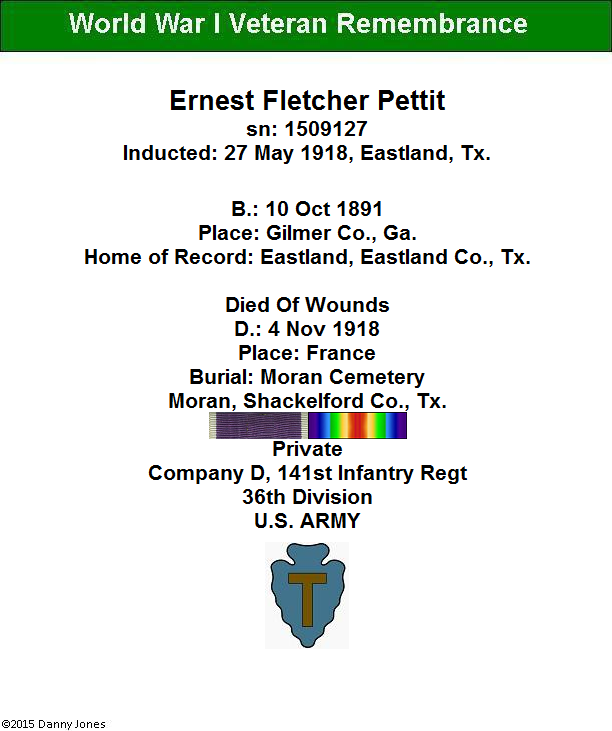
Mr. Ernest Fletcher Pettit, a single white male living in Moran, Shackelford County, Texas and working as a farmer for himself in Eastland County as of June 5, 1917. Ernest was tall and slender build with brown hair and gray eyes and a tan complexion. Born in Gilmer County, Georgia on October 10, 1891 to William L. and Sarah A. Pettit, and was raised in Gilmer County, Georgia. Ernest was reported as living with his parents and siblings in JP3 Bosque County, Texas in the 1900 census. Ernest's father died in 1910. Ernest was reported as living with his mother and two brothers in JP4 Jones County, Texas in the 1910 census. Ernest's mother, Mrs. Sue A. Pettit of Moran, Texas, is listed as next of kin on his Army record.
Ernest was enlisted into service for the Texas National Guard on May 27, 1918 at Eastland, Texas. Recruit Pettit was sent to boot camp at Camp Bowie in Fort Worth. Private Pettit was assigned to Company D 141st Infantry Regiment 36th Division at Camp Bowie in Fort Worth. The first units of the 36th Division arrived in France May 31, 1918 and the last on August 14, 1918. Private Pettit's unit moved to Camp Mills, New York then to the port of embarkation in Hoboken, New Jersey and boarded the transport ship to France on July 26, 1918 for the eleven day voyage to France. The 36th Division was stationed at Bar-sur-Aube until September 26, 1918, conducting training with the French Army. The division's Meuse-Argonne operations commenced October 6th, the 36th Division took an active part in the operations of the 4th French Army, advancing a distance of twenty-one kilometers to the Aisne river where it was relieved on the night of October 27th to 28th and withdrawn to the Thiaucourt rest area, and it was between Somme-Py and Givry during this battle that Ernest was wounded in action. Private Pettit died of the wounds November 4, 1918, and buried near the battlefield. His mother was notified.
Private Ernest F. Pettit was buried in a temporary grave there in France to be later repatriated to America. The Graves Registration Service of the US Army was Ernest's new unit. The GRS did an awesome job during and after the battles of WW1. Ernest's remains were loaded onto the USAT Wheaton in Antwerp, Belgium and departed on August 6, 1921 and arrived in Hoboken New Jersey on August 20, 1921. Then shipped August 26, 1921 by train to Moran, Texas arriving September 1, 1921. Ernest Pettit was laid to rest in the Moran Cemetery, Moran, Shackelford County, Texas. Survived by his mother.


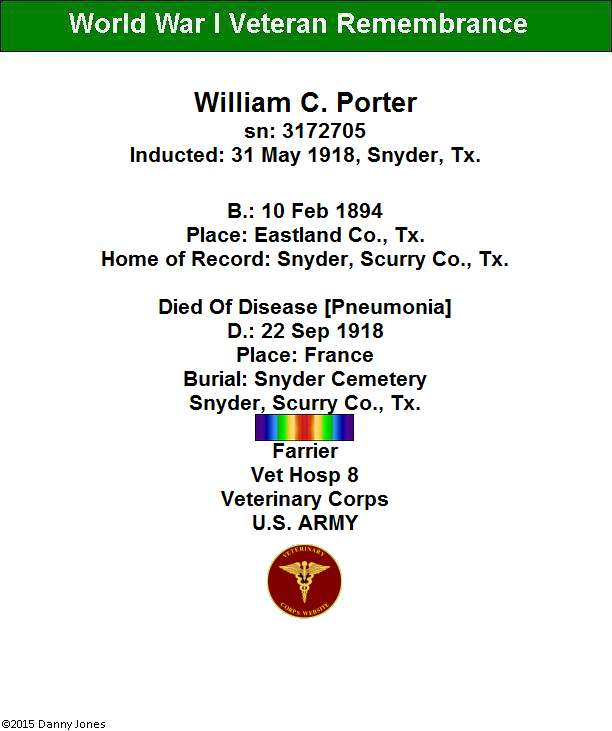
Mr. William Carroll Porter, a single white male living in Snyder, Scurry County, Texas and working as a stock farmer for Sid Johnson in Scurry County as of June 5, 1917. William was medium height and medium build with light color hair and gray eyes and a tan complexion. Born in Eastland County, Texas on February 10, 1894 to Scott C. and Tabitha J. Porter, and was raised in Gilmer County, Georgia. William 'Carl' was reported as living with his parents and siblings in JP4 Eastland County, Texas in the 1900 census. William 'Carol' was reported as living with his parents and siblings in Snyder, Scurry County, Texas in the 1910 census. William's father, Mr. Scott C. Porter of Snyder, Texas, is listed as next of kin on his Army record.
William was drafted into federal service for the US Army on May 31, 1918 at Snyder, Scurry County, Texas. Recruit Porter was sent to Camp Lee in Virginia. Private Porter was assigned to Veterinary Hospital 8 in the Veterinary Corps for training in the care of US Army horses and mules. William was promoted to Farrier on July 1, 1918. Farrier Porter's unit moved to the port of embarkation in Hoboken, New Jersey and boarded the transport ship to France on July 26, 1918 for the eleven day voyage to France. The Veterinay Hospital 8 was located at Claye-Souilly, France. Farrier Porter died of the pneumonia September 22, 1918, and buried near Juilly, France. His father was notified.
Farrier William C. Porter was buried in a temporary grave there in France to be later repatriated to America. The Graves Registration Service of the US Army was William's new unit. The GRS did an awesome job during and after the battles of WW1. William's remains were loaded onto the USAT Cambrai in Antwerp, Belgium and departed on May 23, 1921 and arrived in Hoboken New Jersey on June 6, 1921. Then shipped June 23, 1921 by train to Snyder, Texas arriving June 29, 1921. William Porter was laid to rest in the Snyder Cemetery, Snyder, Scurry County, Texas. Survived by his parents.


Mr. Payton Grady Ramsey, a single white male living in Carbon, Eastland County, Texas and working as farm laborer for J. T. Poe in Eastland County as of June 5, 1917. Payton was of tall and a slender build with light color hair and blue eyes, and probably a very tan complexion from all of the farm work. Born in Woods, Liberty County, Florida August 22, 1896 to John A. and Ella A. Ramsey, and he was raised there in Liberty County. Peyton was reported living with his parents and siblings in JP5 Panola County, Texas in the 1900 census. Payton's father died in 1909. In the 1910 census, Payton 'Fody' is reported as living with his mother, Ella A., and siblings in JP4 Eastland County, Texas. Payton's Army record lists his mother, Mrs. J. A. Ramsey, as next of kin and living in Cisco, Texas.
Payton was drafted into federal service for the US Army on July 22, 1918 at Eastland, Texas. Recruit Ramsey was sent to boot camp at Camp Travis in San Antonio on July 23, 1918. Private Ramsey was in Camp Travis for training with the 165th Depot Brigade. On August 20, 1918 Payton was assigned to Company 2 Casual Regiment at Camp Wheeler, Georgia. On September 2, 1918 Private Ramsey was assigned to Company D 124th Infantry Regiment 31st Infantry Division. Two weeks later, they moved out to Camp Mills, New York. Payton got sick, probably the influenza and he died of pneumonia on October 16, 1918. His mother was notified.
Private Payton G. Ramsey's body was shipped by train to Eastland, Texas. Payton was laid to rest in the Romney Cemetery, Romney, Eastland County, Texas. Survived by his mother.


Mr. William Noah Ross, a single white male living in Pioneer, Eastland County, Texas and working as farmer for himself near Pioneer as of June 5, 1917. William was of tall and a slender build with light brown hair and light blue eyes, and probably a very tan complexion from all of the farm work. Born in Leon Junction, Coryell County, Texas August 9, 1886 to Mr. Ross and Mary Elizabeth Ross, and he was raised there in Coryell County. William's father died about 1892. William was reported living with his mother and step-father, Alfred Shirley, and step-sisters in JP3,6 Callahan County, Texas in the 1900 census. William was reported living with his mother and step-father, Alfonzo Shirley, and step-siblings in JP7 Eastland County, Texas in the 1910 census. William's Army record lists his mother, Mrs. Mary E. Shirley, as next of kin and living in Pioneer, Texas.
William was drafted into federal service for the US Army on August 7, 1918 at Eastland, Texas. Recruit Ross was sent to boot camp at Camp Cody in New Mexico. Private Ross was in Camp Cody for training with the 3rd Training Company in Casual Camp of Camp Cody. On August 15, 1918 William was assigned to Company G 133rd Infantry Regiment 34th Division. William got sick, probably the influenza and he died of pneumonia on August 28, 1918. His mother was notified.
Private William N. Ross's body was shipped by train to Pioneer, Texas. William was laid to rest in the Pioneer Cemetery, Pioneer, Eastland County, Texas. Survived by his mother.

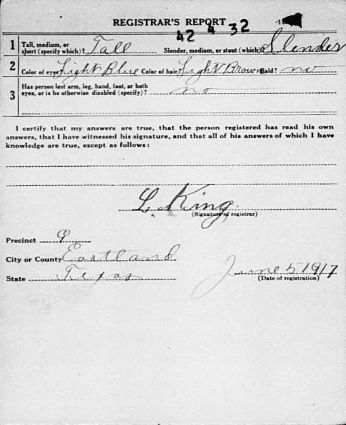


Mr. George R. Scott, a single white male living in Rising Star, Eastland County, Texas and his employment in Bronte, Texas as of July 16, 1917. George did not register for the draft. Born in Amarillo, Potter County, Texas on October 5, 1898 to Guy Ray and Katherine Scott, and was raised in Potter County, Texas. George was not found in the 1900 census. George was reported as living with his parents and siblings in JP2 Scurry County, Texas in the 1910 census. George's mother of Rising Star, Texas is listed as next of kin on his Army record.
George was enlisted into service for the Texas National Guard on July 16, 1917 at El Paso, Texas. Recruit Scott was sent to boot camp at Camp Bowie in Fort Worth. George was given assignment for training to the Company A 1st Infantry Texas National Guard. When the Texas National Guard was put into the US Army about August 20, 1917, Private Scott was assigned to Company A 141st Infantry Regiment 36th Division at Camp Bowie in Fort Worth. Private Scott was promoted to Corporal on April 23, 1918, and then to Sergeant on June 1, 1918 at Camp Bowie. The first units of the 36th Division arrived in France May 31, 1918 and the last on August 14, 1918. Sergeant Scott's unit moved to Camp Mills, New York then to the port of embarkation in Hoboken New Jersey and boarded the transport ship to France on July 26, 1918 for the eleven day voyage to France. The 36th division was stationed at Bar-sur-Aube until September 26, 1918, conducting training with the French Army. The division's Meuse-Argonne operations began October 7, 1918, and it was between Somme-Py and Givry during this battle that George was killed in action October 8, 1918, and buried near the battlefield. His mother was notified.
Sergeant George R. Scott was buried in a temporary grave there in France to be later repatriated to America. The Graves Registration Service of the US Army was George's new unit. The GRS did an awesome job during and after the battles of WW1. George's remains were loaded onto the USAT Wheaton in Antwerp, Belgium and departed on August 6, 1921 and arrived in Hoboken New Jersey on August 20, 1921. Then shipped September 2, 1921 by train to Lubbock, Texas arriving September 9, 1921. George Scott was laid to rest in the Lubbock City Cemetery, Lubbock, Lubbock County, Texas. Survived by his parents. On April 1, 1919 Sergeant George Scott was awarded posthumously the French Croix de Guerre with palm for his courage in battle.


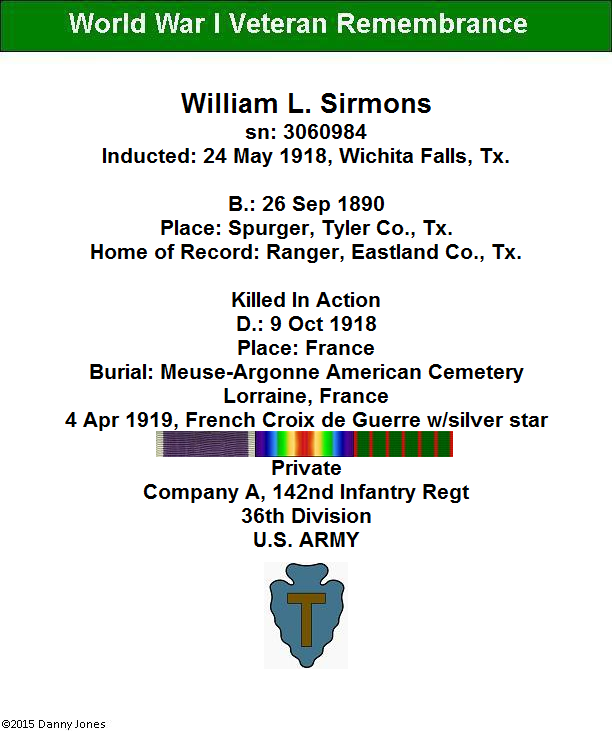
Mr. William Lee Sirmons, a single white male living in Iowa Park, Wichita County, Texas and working as an oil field laborer for the Texas Oil Company in Wichita County, Texas as of June 5, 1917. William was medium height and medium build with brown hair and blue eyes with a tan complexion. Born in Spurger, Tyler County, Texas on September 26, 1890 to William T. and Sarah Sirmons, and was raised in Tyler County, Texas. William was not found in the 1900 census. William was reported as living with his parents and siblings in JP2 Scurry County, Texas in the 1910 census. William's sister of Ranger, Eastland County, Texas is listed as next of kin on his Army record.
William was drafted into federal service for the US Army on May 24, 1918 at Wichita Falls, Texas. Recruit Sirmons was sent to boot camp at Camp Travis in San Antonio. William was given assignment for training to the 33rd Company 9th Training Battalion 165th Depot Brigade. On June 20, 1918, Private Sirmons was assigned to Company A 142nd Infantry Regiment 36th Division at Camp Bowie in Fort Worth. The first units of the 36th Division arrived in France May 31, 1918 and the last on August 14, 1918. Private Sirmons's unit moved to Camp Mills, New York then to the port of embarkation in Hoboken New Jersey and boarded the transport ship to France on July 31, 1918 for the eleven day voyage to France. The 36th division was stationed at Bar-sur-Aube until September 26, 1918, conducting training with the French Army. The division's Meuse-Argonne operations began October 7, 1918, and it was between Somme-Py and Givry during this battle that William was killed in action October 9, 1918, and buried near the battlefield. His sister was notified.
Private William L. Sirmons was buried in a temporary grave there in France to be later reinterred on October 6, 1921 in the Meuse-Argonne↘ American Cemetery, Lorraine, France. The Graves Registration Service did an awesome job during and after the battles of WW1. Survived by his parents. On April 4, 1919 Private William Sirmons was awarded posthumously the French Croix de Guerre with silver star for his courage in battle.


Mr. Thomas Roscoe Smith, a single white male living in Lindsay, Garvin County, Oklahoma and working as a clerk for W. T. Smith as of June 5, 1917. Thomas was medium height and medium build with brown hair and gray eyes and a normal complexion. Born in Colorado City, Mitchell County, Texas on September 26, 1890 to William T. and Emma Smith, and was raised in Mitchell County, Texas. Thomas was reported as living with his parents and siblings in JP4,7 Stephens County, Texas in the 1900 census. Thomas's mother died after June 12th in 1900. Thomas was reported as living with his father and step-mother, Lula P., and siblings in JP7 Stephens County, Texas in the 1910 census. Thomas's father of Cisco, Texas is listed as next of kin on his Army record.
Thomas was drafted into federal service for the US Army on or about May 24, 1918 at Garvin County, Oklahoma. Recruit Smith was sent to boot camp at Camp Bowie in Fort Worth. Private Smith was assigned to Company E 141st Infantry Regiment 36th Division at Camp Bowie in Fort Worth. The first units of the 36th Division arrived in France May 31, 1918 and the last on August 14, 1918. Private Smith's unit moved to Camp Mills, New York then to the port of embarkation in Hoboken New Jersey and boarded the transport ship to France on July 31, 1918 for the eleven day voyage to France. The 36th division was stationed at Bar-sur-Aube until September 26, 1918, conducting training with the French Army. The division's Meuse-Argonne operations began October 7, 1918, and it was between Somme-Py and Givry during this battle that Thomas was killed in action October 10, 1918, and buried near the battlefield. His father was notified.
Private Thomas R. Smith was buried in a temporary grave there in France to be later repatriated to America. The Graves Registration Service of the US Army was Thomas's new unit. The GRS did an awesome job during and after the battles of WW1. Thomas's remains were loaded onto the USAT Wheaton in Antwerp, Belgium and departed on August 6, 1921 and arrived in Hoboken New Jersey on August 20, 1921. Then shipped September 2, 1921 by train to Cisco, Texas arriving September 7, 1921. Thomas Smith was laid to rest in the Gunsight Cemetery at Gunsight, Stephens County, Texas. Survived by his father.

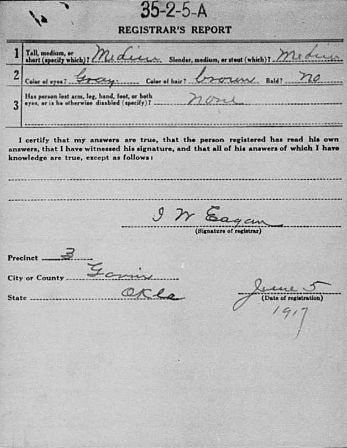


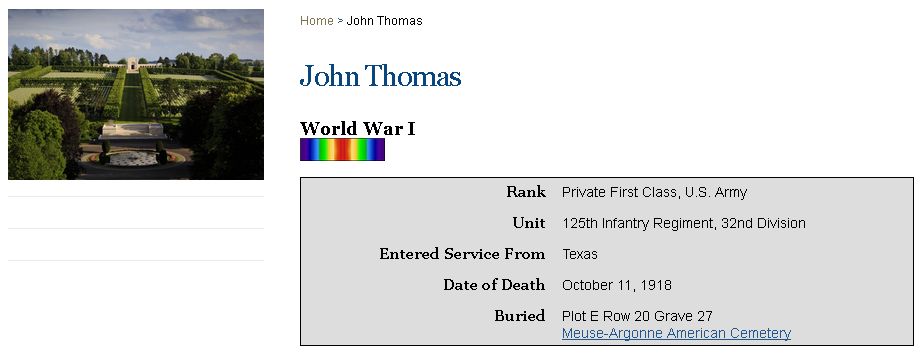
Mr. John Thomas, a single white male living in Goliad, Goliad County, Texas and working as farm laborer for J. F. Thomas as of June 5, 1917. John was tall and medium build with black hair and brown eyes and a tan complexion. John was born in Cisco, Eastland County, Texas on December 18, 1889 to John and Mollie Thomas, and raised there in Eastland County. John was not found in both the 1900 and 1910 censuses. John's father is listed on his Army record as next of kin living in Goliad, Texas.
John was drafted into federal service for the US Army on September 19, 1917 at Goliad, Texas. Recruit Thomas was sent to Camp Travis in San Antonio for training with Company M 360th Infantry Regiment. On March 18, 1918, Private Thomas was assigned to 2nd Company April Auto Replacement Draft Camp Travis and they moved out to Camp Mills, New York then to port of embarkation in Hoboken, New Jersey and boarded the transport ship to France on April 7, 1918 for the 11 day voyage to France. Upon arrival in France the division was ordered to the St. Aignan training area. The division was then broken up and formed into training cadres for the instruction of replacements for combat divisions at the front.
On April 21, 1918 John was assigned to the Company H 163rd Infantry Regiment 41st Division. On April 27, 1918, John was assigned to the Company A 125th Infantry Regiment 32nd Division for more training. On May 15, 1918, the status of the 32nd Division was changed to a combat division and moved into Alsace where it took over a front-line sector near Belfort. Private Thomas was promoted to Private 1st Class on July 8, 1918. The 32nd Division held this sector until July 21st when it was relieved by the French and ordered to the Ourcq where it relieved the 3rd Division in the Aisne-Marne offensive on July 30th. In this offensive the 32nd Division broke the German line of resistance on the Ourcq and drove the enemy back to the heights of the Vesle making a total advance of nineteen kilometers. On August 28, 1918 the 32nd Division entered the front line northeast of Soissons as a part of the French 10th Army and contributed to an important extent to the success of the French in outflanking the German line on the Chemin-des-Dames. In this drive the 32nd Division captured the strong German position on the Juvigny plateau, advancing to a depth of five and a half kilometers. On September 2, 1918, the 32nd Division was relieved by the 2nd Moroccan Division and sent back to Joinville for a rest period. On September 20th the division left the Joinville rest area and moved by bus to the Meuse-Argonne front. On September 30, 1918 the 32nd Division entered the front line before the Kriemhilde Stellung near Romagne-sous-Montfaucon. In a series of attacks during the next three weeks the division penetrated the enemy position to a depth of eight and a half kilometers. During this offensive PFC Thomas was wounded in action and died of the wounds on October 11, 1918. His father was notified.
Private 1st Class John Thomas was buried in a temporary grave there in France to be later reinterred on November 24, 1921 in the Meuse-Argonne↘ American Cemetery at Romagne-sous-Montfaucon, France. The GRS did an awesome job during and after the battles of WW1. Survived by his parents.


Mr. Finis E. Walker, a single white male living in Cisco, Eastland County, Texas and his employment unknown as of May 3, 1917. Born in Bowie, Montague County, Texas on January 3, 1893 to Willie J. and Mollie L. Walker and raised there in Montague County. Finis was found living with his parents and siblings in JP6 Cisco, Eastland County, Texas on the 1900 and on the 1910 censuses. Finis's father, W. J. Walker of Cisco, Texas, is listed as next of kin on his Army record.
Finis was enlisted into federal service for the US Army on May 3, 1917 at Ft Sam Houston, Texas. Private Walker was sent to Fort Monroe, Alabama assigned to Company 2 Coast Artillery Corps. On August 6, 1917 Private Walker was sent to Fort McPherson, Georgia assigned to the Bakery Company 23 in the Quartermaster Corps. On August 25, 1917 Finis was reassigned to Bakery Company 41 in the Quartermaster Corps Fort McPherson, Georgia. Private Walker was promoted to Private 1st Class on October 4, 1917 and sent to Bakery Company 329 Quartermaster Corps at Camp Jackson, South Carolina. On May 4, 1918 Finis was sent to Bakery Company 380 Quartermaster Corps at Fort Bayard, New Mexico. On June 10, 1918 PFC Walker was promoted to Sergeant. Finis was sick with the TB and died in the base hospital on February 16, 1919. His father was notified.
Sergeant Finis E. Walker was laid to rest in the Oakwood Cemetery at Cisco, Eastland County, Texas. Survived by his parents.


Mr. Fritz Wende, a single white male living in Cisco, Eastland County, Texas and working as a farmer for himself four miles south of Cisco as of June 5, 1917. Fritz was of tall and stout build with brown hair and gray eyes and a tan complexion. Born in Eastland County, Texas on August 10, 1890 to Daniel and Emilie Wende, and raised there in Eastland County during his childhood. Fritz 'Friederick Wenda' found living with his parents and siblings in JP6 Eastland County on the 1900 census. Fritz 'Windes' found living with his parents and siblings in JP6 Eastland County on the 1910 census. Fritz's father died in 1915. Fritz's mother of Cisco, Eastland County, Texas is listed as next of kin on his Army record.
Fritz was drafted into federal service for the US Army on May 27, 1918 at Eastland, Texas. He was sent to boot camp at Camp Bowie in Fort Worth. Private Wende was in Camp Bowie for training with the Company F 111th Engineer Regiment 36th Division. On July 5, 1918, Private Wende was assigned to the Engineers Replacement Depot APO 133, soon after his assignment they moved out to Camp Mills New York. Then to the port of embarkation in Hoboken New Jersey and boarded the transport ship to France on October 20, 1918 for the eleven day voyage to France. But then, only a few days after reaching France Fritz's company spent time training then were assigned to the Company B 126th Engineers Regiment of the Corps of Engineers doing general railway construction. After the armistice signing Private Wende's regiment was with the American Army of Occupation in France and continued their work. It was at this final post near Lambezellec, Finistere where he became sick and died on February 22, 1919 of meningitis. His mother was notified.
Private Fritz Wende was buried in a temporary grave there in France to be later repatriated to America. The Graves Registration Service of the US Army was Fritz's new unit. The GRS did an awesome job during and after the battles of WW1. Fritz's remains were loaded onto the USAT St. Mihiel in Antwerp, Belgium on November 17, 1921 and arrived in Hoboken New Jersey on December 16, 1921. Then shipped January 9, 1922 by train to Cisco, Texas arriving January 13, 1922. Fritz Wende was laid to rest in the Redeemer Lutheran Cemetery at Cisco, Eastland County, Texas. Survived by his mother.


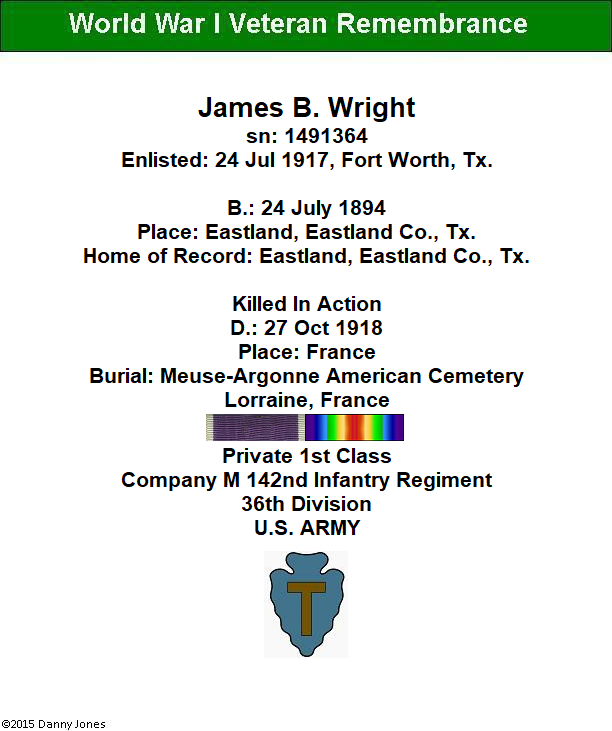
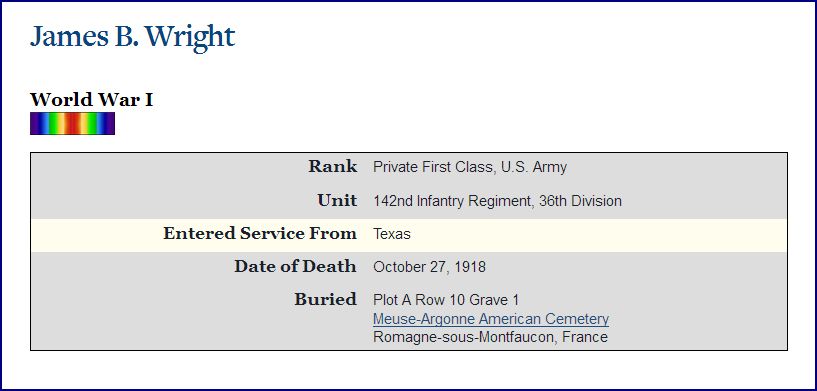
Mr. James B. Wright, a single white male living in Eastland, Eastland County, Texas and his employment not known as of July 24, 1917. James did not register for the draft. Born in Eastland, Eastland County, Texas in July 24, 1894 to James R. and Thena A. Wright, and was raised in Eastland County, Texas. James was reported as living with his parents and siblings in JP1 Eastland, Eastland County, Texas in the 1900 census. James was reported as living with his parents and siblings in JP1 Eastland County, Texas in the 1910 census. James's father of Eastland, Texas is listed as next of kin on his Army record.
James was enlisted into service for the Texas National Guard on July 24, 1917 at Fort Worth, Texas. Recruit Wright was sent to boot camp at Camp Bowie in Fort Worth. James was given assignment for training to the Company K 7th Infantry Texas National Guard. When the Texas National Guard was put into the US Army about August 20, 1917, Private Wright was assigned to Company M 142nd Infantry Regiment 36th Division at Camp Bowie in Fort Worth. Private Wright was promoted to Private 1st Class on December 1, 1917. The first units of the 36th Division arrived in France May 31, 1918 and the last on August 14, 1918. On July 4, 1918 PFC Wright and the 36th Division left for Camp Mills, Long Island, New York. Sailed from Hoboken, New Jersey on July 18,1918 for the eleven day voyage to France. Units of the 36th Division arriving at Brest, St. Nazaire, Le Havre and Bordeaux, beginning July 30th, thence proceeding to the 13th training area in vicinity of Bar-sur-Aube. On September 27, 1918 the 36th Division left for the Champagne section, detraining at Epernay and vicinity. Commencing October 6th, the division took an active part in the Meuse-Argonne operations of the 4th French Army, advancing a distance of twenty-one kilometers to the Aisne river where it was relieved on the night of October 27th to 28th and withdrawn to the Thiaucourt rest area. It was between Somme-Py and Givry during this offensive that James was killed in action October 27, 1918, and buried near the battlefield. His father was notified.
Private 1st Class James B. Wright was buried in a temporary grave there in France to be later reinterred on November 9, 1921 in the Meuse-Argonne↘ American Cemetery at Romagne-sous-Montfaucon, France. The GRS did an awesome job during and after the battles of WW1. Survived by his parents.