![[tex flag]](../../images/usa_vet.png) Heart of Texas World War One, Rem Bios & Records, Comanche County Texas
Heart of Texas World War One, Rem Bios & Records, Comanche County Texas ![[usa flag]](../../images/tex_flag.png)

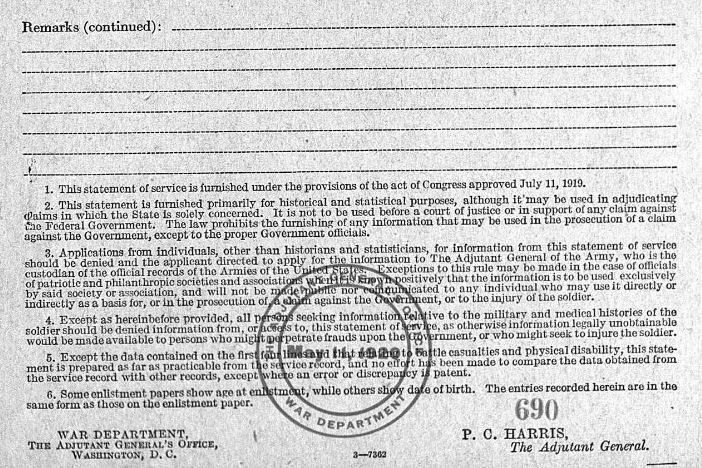
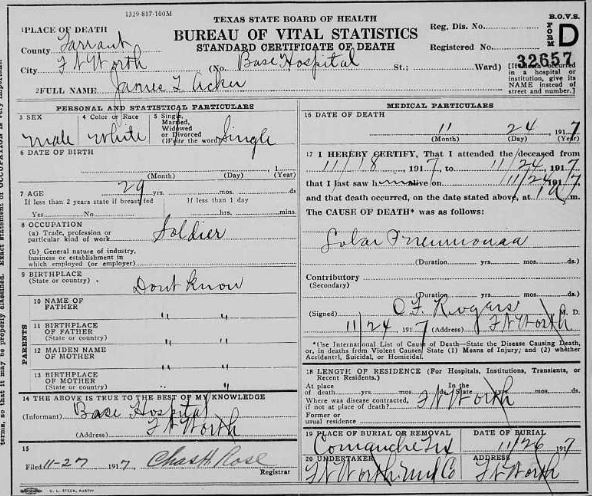
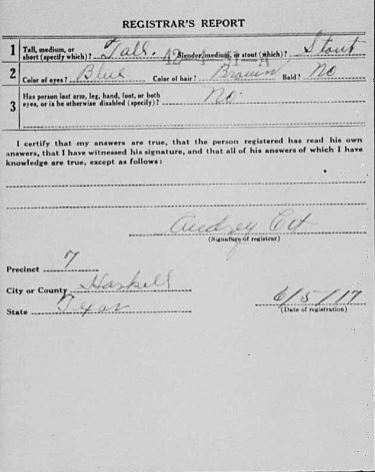
Mr. James T. Acker, a single white male living in Democrat, Comanche County, Texas and working as a farm laborer for his father as of June 5, 1917. James was of short and medium build with light brown hair and light blue eyes, and probably a very tan complexion from all of the farm work. Born in Comanche County on January 10, 1893 to George W. and Margaret Ellen Acker, and he was raised there in Comanche County. He was reported living with his parents and siblings in Comanche County, Texas on both the 1900 and 1910 censuses. James's father is listed as the next of kin on his Army record.
James was enlisted into federal service for the US Army on June 19, 1917 at Comanche, Texas. Recruit Acker was sent to boot camp at Camp Bowie in Fort Worth, Texas. Private Acker was in Camp Bowie for training with the Company E 6th Infantry Texas National Guard. His unit was then renamed for national service to Company H 144th Infantry Regiment of the 36th Infantry Division. James was there only a few months when he got sick, probably the influenza, and died of pneumonia on November 24, 1917. His father was notified in Democrat, Texas.
![[Army]](../../images/sealArmy.png) Private James T. Acker was laid to rest in the Mercers Gap Cemetery at Comanche County, Texas on November 26, 1917.
Private James T. Acker was laid to rest in the Mercers Gap Cemetery at Comanche County, Texas on November 26, 1917.


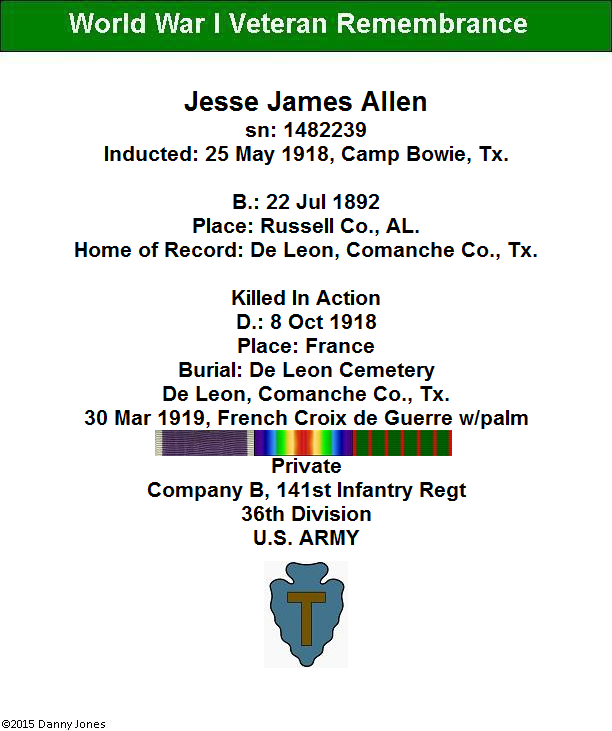
Mr. Jesse James Allen, a single white male living in DeLeon, Comanche County, Texas and he was working as a farmer for himself as of June 5, 1917. Jesse was medium height and medium build with brown color hair and blue eyes and probably a tan complexion. Born in Russell County, Alabama on July 22, 1892 to Henry W. and Sarah E. Allen, and was raised in Girard, Russell County, Alabama. Jesse was reported as living with his parents and siblings in Girard, Russell County, Alabama on the 1900 census. Jesse was reported as living with his parents and siblings in JP5, Coleman County, Texas on the 1910 census. He registered for the draft in Comanche County. Jesse's father died November 1917. Jesse's mother of DeLeon, Texas is listed as next of kin on his Army record.
Jesse was drafted into federal service for the US Army on May 25, 1918 at Camp Bowie, Texas. Recruit Allen was sent to boot camp at Camp Bowie in Fort Worth. Private Allen was assigned to Company B 141st Infantry Regiment 36th Division at Camp Bowie. The first units of the 36th Division arrived in France May 31, 1918 and the last on August 14, 1918. Private Allen's unit moved to the port of embarkation in Hoboken New Jersey and boarded the transport ship to France on July 26, 1918 for the eleven day voyage to France. The 36th division was stationed at Bar-sur-Aube until September 26, 1918, conducting training with the French Army. The division's Meuse-Argonne operations began October 7, 1918, and it was between Somme-Py and Givry during this battle that Jesse was killed in action October 8, 1918, and buried on the battlefield. His mother was notified.
Private Jesse J. Allen was buried in a temporary grave there in France to be later repatriated to America. The Graves Registration Service of the US Army was Jesse's new unit. The GRS did an awesome job during and after the battles of WW1. Jesse's remains were loaded onto the USAT Wheaton in Antwerp, Belgium on August 6, 1921 and arrived in Hoboken New Jersey August 20, 1921. Then shipped September 9, 1921 by train to DeLeon, Texas arriving September 18, 1921. Jesse Allen was laid to rest in the DeLeon Cemetery, Comanche County, Texas. Survived by his mother. He was awarded the French Croix de Gurre with palm posthumasly on March 30, 1919 for his courage and bravery.


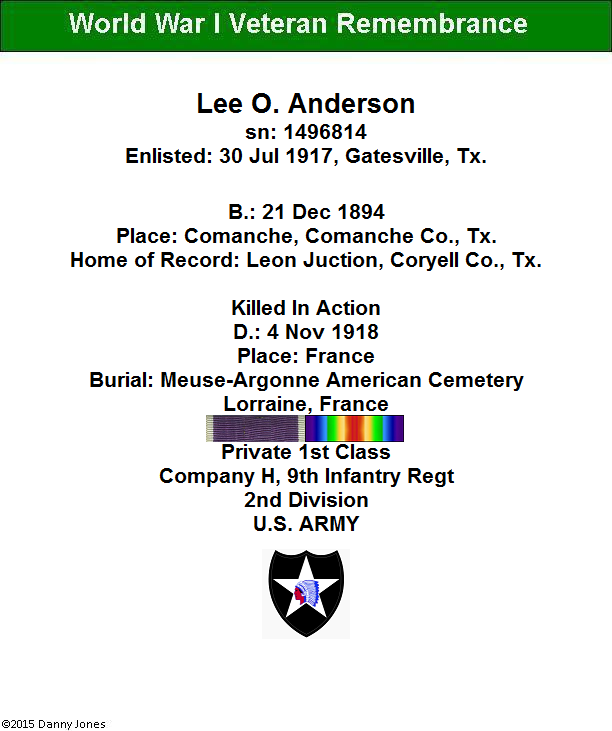
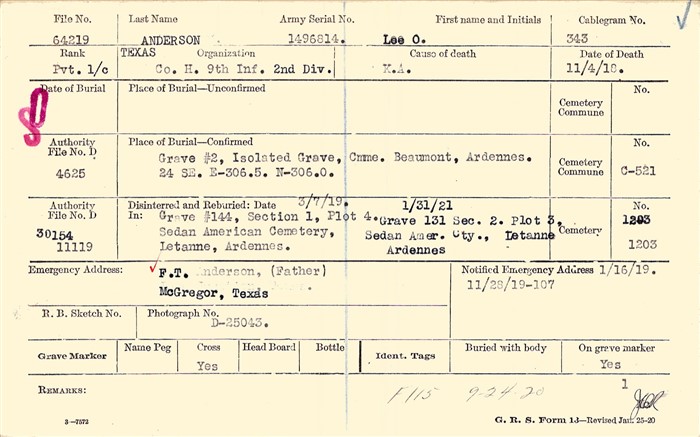
Mr. Lee O. Anderson, a single white male living in Leon Junction, Coryell County, Texas and he was working as a farmer for himself as of June 5, 1917. Lee was of short and slender build with brown hair and blue eyes and probably a tan complexion. Born in Comanche, Comanche County, Texas on December 21, 1894 to Tillman F. and Lydia Anderson, and was raised in Comanche County, Texas. Lee was reported as living with his parents and siblings in Gonzales County, Texas on the 1900 census. Lee was not reported as living with his parents and siblings in Comanche County, Texas on the 1910 census. He registered for the draft in Coryell County. His father, Tillman Francis Anderson of Leon Junction, Texas is listed as next of kin on his Army record.
Lee was enlisted into federal service for the US Army on July 30, 1917 at Gatesville, Texas. Recruit Anderson was sent to boot camp at Camp Bowie in Fort Worth. Lee was given assignment for training to the Company L 6th Infantry Regiment Texas National Guard. On October 15, 1917 Private Anderson was assigned to Company A 144th Infantry Regiment 36th Division at Camp Bowie. The first units of the 36th Division arrived in France May 31, 1918 and the last on August 14, 1918. Lee was promoted to Private 1st Class on June 8, 1918. Private 1st Class Anderson's unit moved to the port of embarkation in Hoboken New Jersey and boarded the transport ship to France on July 18, 1918 for the eleven day voyage to France. The 36th division was stationed at Bar-sur-Aube, and on August 22, 1918 Private 1st Class Anderson was transferred to the Company H 9th Infantry Regiment 2nd Division at the vicinity of Nancy. On August 6 the division relieved a French unit in the Marbache sector where it remained until relieved by the 82nd division on August 16, 1918. The division's Saint Mihiel operations were September 12-16, 1918. The division's Meuse-Argonne operations began October 1, 1918, and it was between Thiaucourt and Blanc Mont Ridge during this battle that Lee was killed in action on November 4, 1918, and buried on the battlefield. His father was notified.
Private 1st Class Lee O. Anderson was buried in a temporary grave there in France to be later reinterred on November 8, 1921 in the Meuse-Argonne↘ American Cemetery at Romagne-sous-Montfaucon, France. The GRS did an awesome job during and after the battles of WW1. Survived by his parents.




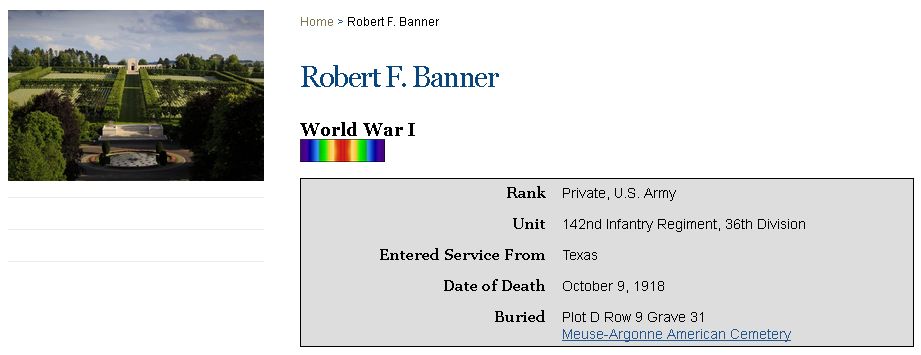
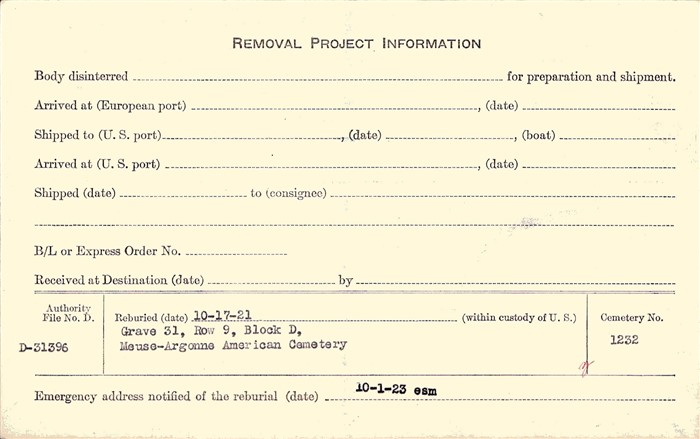
Mr. Robert Foster Banner, a single white male living in Merkel, Taylor County, Texas and he was working at his father's harness shop as of July 13, 1917. Robert was not required to register for the draft. Born in Comanche County, Texas on December 12, 1897 to Jacob L. and Sabrina Arminda Banner, and was raised in Comanche County, Texas. Robert was reported as living with his parents and siblings in JP2 Comanche County, Texas in the 1900 census. Robert was reported as living with his parents and siblings in Merkel, Taylor County, Texas in the 1910 census. His father of Merkel, Texas is listed as next of kin on his Army record.
Robert was enlisted into federal service for the US Army on July 13, 1917 at Abilene, Texas. Recruit Banner was sent to boot camp at Camp Bowie in Fort Worth. Robert was given assignment for training to the Company I 7th Infantry Texas National Guard. Robert was assigned to Cook duty on September 14, 1917. On October 15, 1917 Private Banner was assigned to Headquarters Company 142nd Infantry Regiment 36th Division at Camp Bowie in Fort Worth. He was relieved of Cook duty on January 1, 1918. The first units of the 36th Division arrived in France May 31, 1918 and the last on August 14, 1918. Private Banner's unit moved to the port of embarkation in Hoboken New Jersey and boarded the transport ship to France on July 18, 1918 for the eleven day voyage to France. The 36th division was stationed at Bar-sur-Aube until September 26, 1918, conducting training with the French Army. The division's Meuse-Argonne operations began October 7, 1918, and it was between Somme-Py and Givry during this battle that Robert was killed in action October 9, 1918, and buried near the battlefield. His father was notified.
Private Robert F. Banner was buried in a temporary grave there in France to be later reinterred on October 17, 1921 in the Meuse-Argonne↘ American Cemetery at Romagne-sous-Montfaucon, France. The GRS did an awesome job during and after the battles of WW1. Survived by his parents. On April 4, 1919, Private Robert Banner was awarded posthumously the French Croix de Guerre with silver star for his courage in battle.



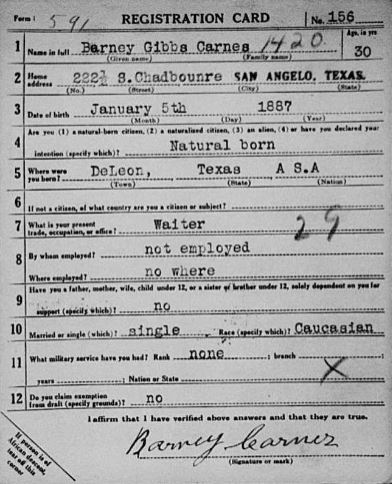
Mr. Barney Gibbs Carnes, a single white male living in San Angelo, Tom Green County, Texas and being an unemployed waiter as of June 5, 1917. Barney was a tall medium build man with brown hair and blue eyes, and probably a normal complexion. Born at De Leon, Comanche County, January 5, 1887 to John and Kate Carnes, and was raised there in Comanche County. Barney and his parents and siblings are reported in the 1900 census as being in Coleman County. Barney's father died in 1907. Barney and his mother and family are reported in the 1910 census as being in Brownwood, Brown County, Texas. Barney's brother, Hoy Carnes, is listed as next of kin on his Army record, and living in Brownwood, Texas.
Barney was drafted into federal service for the US Army on July 15, 1918 at San Angelo, Texas. Recruit Carnes was sent to boot camp at Camp MacArthur in Waco he was assigned to Company B 7th Infantry Training Battalion 57th Depot Brigade. Barney was promoted to Corporal on August 20, 1918. On September 17, 1918 he was assigned to 28th Company Camp MacArthur September Auto Replacement Draft and the day after he was busted back to Private. They moved out to the port of embarkation in New Jersey and boarded the transport ship to France on September 26, 1918 for the eleven day voyage to France. Barney got sick a few days after arriving in France with the measles and died of pneumonia on October 13, 1918 in France. His brother was notified in Brownwood, Texas.
Private Barney G. Carnes was buried in a temporary grave there in France to be later repatriated to America. The Graves Registration Service of the US Army was Barney's new unit. The GRS did an awesome job during and after the battles of WW1. Barney's remains were loaded onto the USAT Nansemond in Brest France on May 13, 1920 and arrived in Hoboken New Jersey on June 3, 1920. Then shipped June 8, 1920 by train to Comanche, Texas arriving June 12, 1920. Barney Carnes was laid to rest in the Oakwood Cemetery, Comanche, Comanche County, Texas. Survived by his mother.
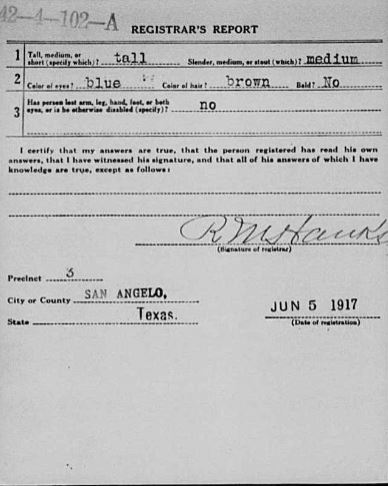


Mr. Brodie Lee Caywood, a single white male living in Rosebud, Falls County, Texas and he was working as a farm laborer for his father as of April 19, 1917. Brodie did not register in the draft. Born in DeLeon, Comanche County, Texas on March 7, 1894 to Valentine 'Bud' and Laura A. Caywood, and was raised in Comanche County, Texas. Brodie was reported as living with his parents and siblings in JP3 Erath County, Texas on the 1900 census. Brodie was reported as living with his parents and siblings in JP5 Comanche County, Texas on the 1910 census. He moved to Rosebud, Falls County sometime between 1910 and 1917. Brodie's father, Bud Caywood of Rosebud, Texas is listed as next of kin on his Army record.
Brodie was enlisted into federal service for the US Army on April 19, 1917 at Ft Sam Houston, Texas. Recruit Caywood was sent to boot camp at Ft Sam Houston in San Antonio and assigned to the Company M 9th Infantry Regiment 2nd Division. Private Caywood's unit moved out to the port of embarkation in New Jersey and boarded the transport ship to France on September 18, 1917 for the eleven day voyage to France. The 2nd Division was organized from elements of the Regular Army and Marines in France during the last three months of 1917. After a period of training while the division headquarters was at Bourmont, Haute-Marne, from October 26, 1917, to March 16, 1918, the division entered the Verdun and Toul sectors with headquarters at Sommedieu. Constant patrolling and several enemy raids were repulsed. Brodie was severely wounded in action on April 14, 1918, and not known when he recovered. On May 31, 1918 moved in to the Chateau-Thierry sector, passing from the 7th A. C. French to the 21st A. C. French as reserve. Went forward about June 1, 1918, to meet a strong enemy attack which had developed on the line west of Chateau-Thierry. The attack of June 3d and 4th was halted June 4th on the line west of Chateau-Thierry and the division advanced two kilometers in the neighborhood of Vaux and in the Belleau Woods, between June 6th and July 1st. The relief of the division was completed July 9, 1918.
On July 16, 1918 the 2nd Division entred the sector south of Soissons and attacked on the morning of the 18th and again on the morning of the 19th, advancing a total distance of eleven kilometers after severe fighting. On July 20th the division moved into reserve position and left the sector. On August 9th the division entered the Marbach sector. This was a quiet sector. Relieved August 24th. Entered the line on the St. Mihiel salient, September 9th, withdrawing September 16th, after having advanced approximately nine kilometers. Entered the front line of the Blanc Mont sector near Somme Py under the French. Relieved October 27th. Entered Meuse-Argonne sector on October 30th and attacked November 1st, advancing to the Meuse. Brodie was killed in action on November 4, 1918, and buried near the battlefield. His father was notified.
Private Brodie L. Caywood was buried in a temporary grave there in France to be later repatriated to America. The Graves Registration Service of the US Army was Brodie's new unit. The GRS did an awesome job during and after the battles of WW1. Brodie's remains were loaded onto the USAT Somme in Calais France on February 27, 1921 and arrived in Hoboken New Jersey on March 14, 1921. Then shipped March 31, 1921 by train to Rosebud, Texas arriving April 5, 1921. Brodie Caywood was laid to rest in the Woodland Cemetery at Rosebud, Falls County, Texas under the auspices of the Brodie Caywood Post of the American Legion. Survived by his parents.


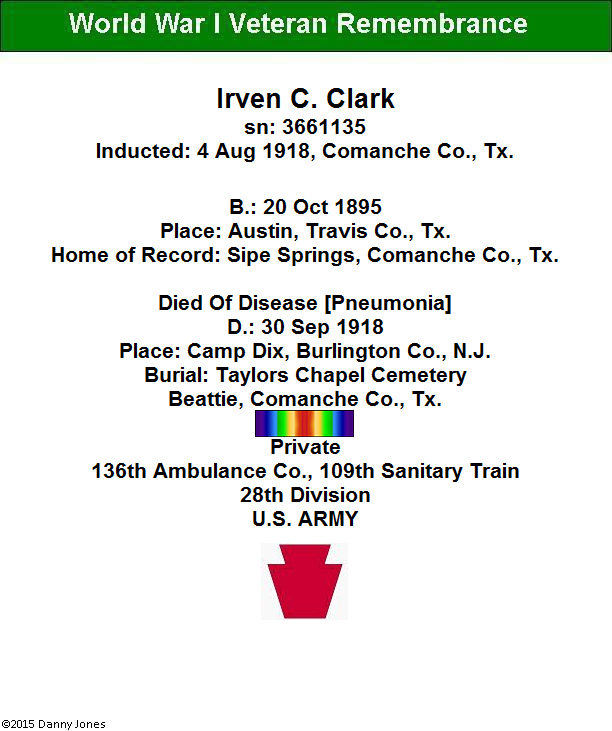
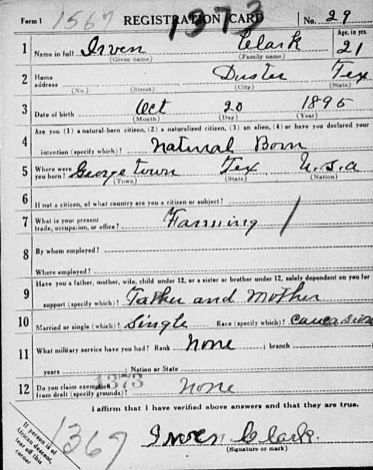
Mr. Irven C. Clark, a single white male living in Duster, Comanche County, Texas and he was working as a farm laborer for his father as of June 5, 1917. Irven was a medium height stout build man with light color hair and blue eyes and a tan complexion from the farm work. Born at Georgetown, Williamson County, October 20, 1895 to William M. and Sarah J. Clark, and was raised there in Williamson County. Irven and his parents and siblings are reported in the 1900 census and 1910 census as being in JP6 Comanche County, Texas. Irven married Miss Delia Brown on December 9, 1917 at Comanche County, Texas. Irven's wife is listed as next of kin on his Army record, and living in Sipe Springs, Texas.
Irven was drafted into federal service for the US Army on August 4, 1918 at Comanche, Texas. Recruit Clark was sent to Camp Cody, New Mexico, he was assigned to 8th Company Casual Training Detachment. He was promoted to Private August 14, 1918, and assigned to the 136th Ambulance Company 109th Sanitary Train 28th Division at Camp Dix, New Jersey. Irven was taken ill with influenza and died of pneumonia in the post hospital at Camp Dix on September 30, 1918. His wife was notified in Sipe Springs, Texas.
Private Irven C. Clark's body was loaded on a railway car and sent by train to Comanche, Texas arriving about October 5, 1918 and his funeral to be afternoon the same day. Irven Clark was laid to rest in the Taylors Chapel Cemetery at Beattie, Comanche County, Texas. Survived by his wife and his parents.


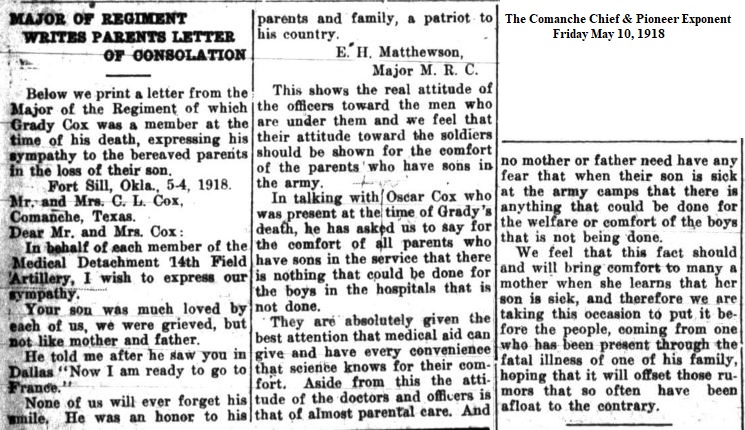
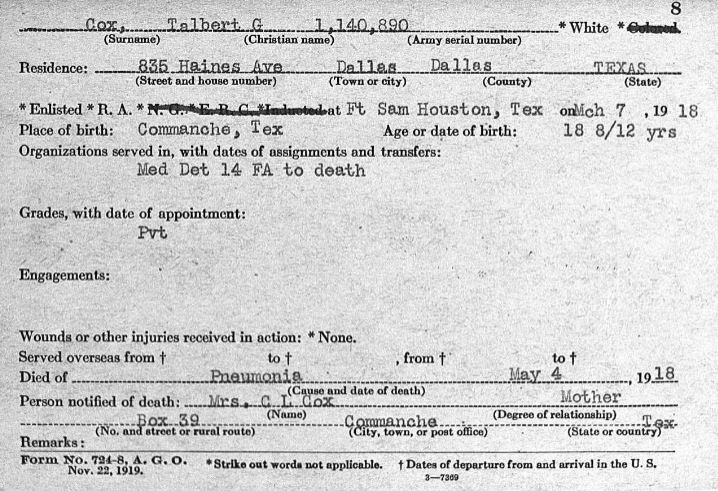
Mr. Talbert Grady Cox, a single white male living in Dallas, Dallas County, Texas and his employment is unknown as of March 7, 1918. Talbert was not required to register for the draft. Born at Comanche, Comanche County, Texas on July 8, 1900 to Claude L. and Mary A. Cox, and was raised there in Comanche, Texas. Talbert and his parents and siblings are reported in the 1910 census as being in Comanche, Comanche County, Texas. Talbert moved to Dallas sometime after graduating high school. Talbert's mother is listed as next of kin on his Army record, and living in Comanche, Texas.
Talbert was enlisted into federal service for the US Army on March 7, 1918 at Ft Sam Houston, Texas. Recruit Cox was sent to Fort Sill, Oklahoma, he was assigned to Medical Detachment with the 14th Field Artillery. Talbert was taken ill with influenza and died of pneumonia in the post hospital at Fort Sill on May 4, 1918. His mother was notified in Comanche, Texas.
Private Talbert G. Cox's body was loaded on a railway car and sent by train to Comanche, Texas arriving Sunday May 5, 1918 and his funeral to be afternoon the same day. Talbert Cox was laid to rest in the Pendergrass Cemetery, Sidney, Comanche County, Texas. Survived by his parents.


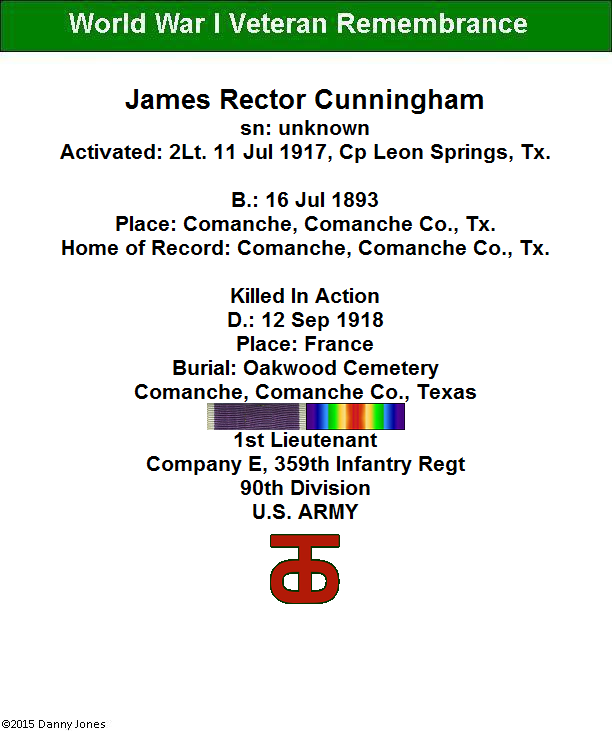
Mr. James Rector Cunningham, a single white male living in Comanche, Comanche County, Texas and working as a clerk for the US government in Leon Springs, Bexar County, Texas as of June 5, 1917. James was of medium height and medium build with black hair and gray eyes. Born in Comanche County, July 16, 1893 to Aaron and Amanda J. Cunningham, and raised there in Comanche County. James is reported living with his parents and siblings in Comanche County in both the 1900 and the 1910 censuses. James's father died in 1914. His father is listed on his Army record as next of kin living at San Saba, Texas.
James was called into active federal service for the US Army on August 15, 1917 at Leon Springs, Texas as a 2nd Lieutenant. James Cunningham was sent to officer training at Camp Funston, Leon Springs, Texas in San Antonio. James was in Camp Travis for training with the Company G 359th Infantry Regiment in the 90th Infantry Division. James's regiment moved out to Camp Mills New York and then to the port of embarkation in Hoboken New Jersey and boarded the transport ship to England on June 20, 1918 for the eleven day voyage to England. But then, only a few days after reaching England James's company entered France and spent time training near Rouvres France for six weeks at eight hours per day. On August 19, 1918, the division moved to the vicinity of Toul. This move was scarcely completed when the division was ordered to relieve the 1st Division in the line in the Villers-en-Haye sector north of Toul, which was completed on August 24, 1918.
The 90th division's St. Mihiel operation was September 12-16, 1918. Lieutenant Cunningham was killed in action on the first day of the 90th Division's St. Mihiel offensive, September 12, 1918. His mother was notified in Comanche, Texas. James was promoted to 1st Lieutenant posthumously, on September 17, 1918.
1st Lieutenant James R. Cunningham was buried in a temporary grave there in France to be later repatriated to America. The Graves Registration Service of the US Army was James's new unit. The GRS did an awesome job during and after the battles of WW1. James's remains were loaded onto the USAT Cambrai in Antwerp Belgium on May 23, 1921 and arrived in Hoboken New Jersey on June 6, 1921. Then shipped June 23, 1921 by train to Comanche, Texas arriving June 29, 1921. James Cunningham was laid to rest in the Oakwood Cemetery, Comanche, Comanche County, Texas. Survived by his mother.


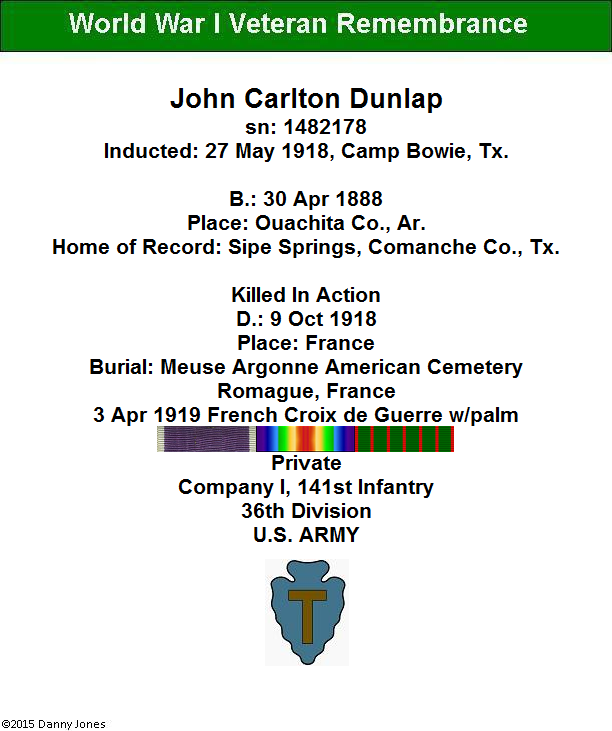
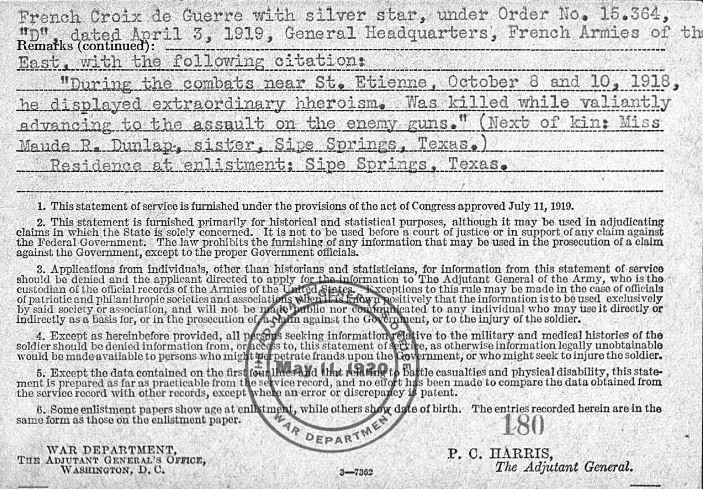
Mr. John Carlton Dunlap, a single white male living in Sipe Springs, Comanche County, Texas and he was working a barber for himself as of June 5, 1917. John was medium height and stout build with light color hair and brown eyes and probably a normal complexion. Born in Ouachita County, Arkansas on April 30, 1888 to Richard A. and Sarah E. Dunlap, and was raised in Ouachita County, Arkansas. John was reported as living with his parents and siblings in JP6 Comanche County, Texas on the 1900 census. John's father died in 1909. John was reported as living with his mother and siblings in JP6 Comanche County on the 1910 census. John's mother died in February 1918. John's sister, Miss Maude R. Dunlap, of Sipe Springs, Texas is listed as next of kin on his Army record.
John was drafted into federal service for the US Army on May 27, 1918 at Camp Bowie, Texas. Recruit Dunlap was sent to boot camp at Camp Bowie in Fort Worth. Private Dunlap was assigned to Company I 141st Infantry Regiment 36th Division at Camp Bowie. The first units of the 36th Division arrived in France May 31, 1918 and the last on August 14, 1918. Private Dunlap's unit moved to the port of embarkation in Hoboken New Jersey and boarded the transport ship to France on June 26, 1918 for the eleven day voyage to France. The 36th division was stationed at Bar-sur-Aube until September 26, 1918, conducting training with the French Army. The division's Meuse-Argonne operations began October 7, 1918, and it was between Somme-Py and Givry during this battle that John was killed in action October 9, 1918, and buried near the battlefield. His sister was notified.
Private John C. Dunlap was buried in a temporary grave there in France to be later reinterred on February 14, 1922 in the Meuse-Argonne↘ American Cemetery at Romagne-sous-Montfaucon, France. The GRS did an awesome job during and after the battles of WW1. Survived by his sister. On April 3, 1919, Private John Dunlap was awarded posthumously the French Croix de Guerre with palm for his courage in battle.




Mr. Thomas Emmitt 'Tom' Fagan, a single white male living in O'Brien, Haskell County, Texas and working as a farmer for himself as of June 5, 1917. Tom was of tall and stout build with brown hair and blue eyes, and probably a very tan complexion from all of the farm work. Born in Comanche County, Texas on October 1, 1892 to Alford M. and Lucy K. Fagan, and he was raised there in Comanche County. Tom was reported living with his parents and siblings in Comanche County, Texas on both the 1900 census. I did not find Tom on the 1910 census. Tom's father is listed as the next of kin on his Army record, living in Comanche County, Texas.
Tom was drafted into federal service for the US Army on September 21, 1917 at Haskell, Texas. Recruit Fagan was sent to boot camp at Camp Travis in San Antonio, Texas. Private Fagan was in Camp Travis for training with the 56th Company 14th Training Battalion 165th Depot Brigade. On October 26, 1917 Tom was sent to Camp Bowie, Texas assigned to Company F 143rd Infantry Regiment of the 36th Infantry Division. Tom was there only a few weeks when he got sick, probably the influenza, and died of pneumonia on December 8, 1917. His father was notified in Comanche, Texas.
Private Tom E. Fagan was laid to rest in the Zion Hill Cemetery at Comanche County, Texas on December 9, 1917. Survived by his parents.



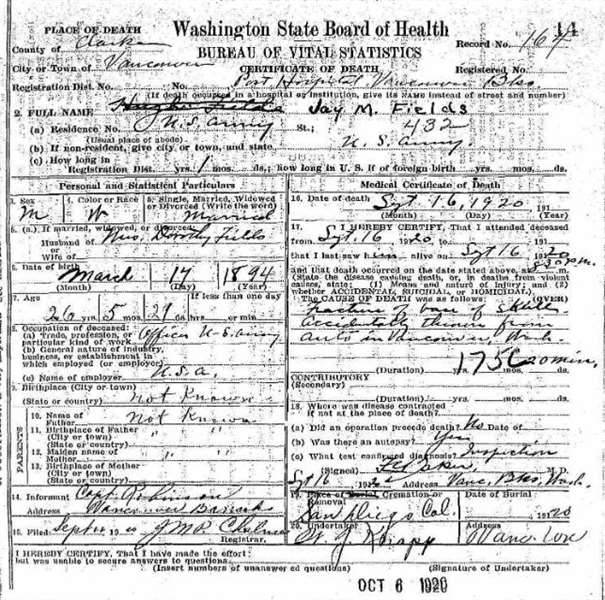
Jay Melvin Fields born 17 March 1891 at Belton, Bell County, Texas to Sarah B. Gartman(b.1851 Alabama-d.1928 Hasse, Comanche County, Texas) Age 42 and Dr Benjamin Franklin Fields (b.1834 Mississippi-d.1909 Comanche, Comanche County, Texas) Age 58. (born John Melvin Fields in Youngsport, Bell County, Texas by most reports, but his nickname 'J' became 'Jay' then he used Jay Melvin as an adult)
1900 census Age 9 (listed as John M.) living with his parents, three brothers and a sister near Belton in JP1 Bell County, Texas. His parents moved to Hasse, Comanche County, Texas before 1909. 1910 census Age 19 (listed as Melville) living with his mother near Hasse in JP1 Comanche County, Texas, working at the home farm. He enlisted in the National Guard Company F 2nd Texas Infantry on 10 May 1916 in Austin and listed his residence in Austin, Texas. Married Miss Dorothy M Graham of Coronado, California on 9 April 1917. He accepted commission of 2nd Lieutenant in the US Army Infantry on 15 August 1917 while residing in Hasse, Texas and listed his wife, Mrs Dorothy M Fields at Coronado, California, as his next of kin contact. 1920 census Age 26 living with his wife at Camp Lewis, Pierce County, Washington.
First Lieutenant Jay Melvin Fields O-unknown US Army 1st Infantry Regiment. He served at Camp Mabry, Texas with the 21st Infantry, and at Ft George Wright, Washington. He served overseas in France from 27 June 1919 to 15 November 1919. He was stationed at Camp Lewis, Washington with the 1st Infantry demobilization when he was killed in an automobile wreck in Vancouver, Washington. On 16 September 1920, he was pronounced dead at the Vancouver Barracks Post Hospital. His body was shipped to San Diego, San Diego County, California and interred in the Fort Rosecrans National Cemetery.



Mr. Aubrey Andrew Fisher, a single white male living in DeLeon, Comanche County, Texas and working as a farmer for himself as of June 5, 1917. Aubrey was medium height and medium build with brown hair and brown eyes, and probably a very tan complexion from all of the farm work. Born in DeLeon, Comanche County, Texas on May 27, 1894 to Alexander L. and Martha J. Fisher, and raised there in Comanche County during his childhood. Aubrey was living with his parents and siblings in JP5 Comanche County, Texas as reported in the 1900 and 1910 censuses. On Aubrey's Army record his father is listed as next of kin and living in DeLeon, Texas.
Aubrey was drafted into federal service for the US Army on March 29, 1918 at Comanche, Texas. He was sent to boot camp at Camp Travis in San Antonio. Private Fisher was in Camp Travis for training with the 11th Company 3rd Training Battalion 165th Depot Brigade. Private Fisher was reassigned for training with the 32nd Company 8th Training Battalion 165th Depot Brigade. On May 29, 1918 Private Fisher was assigned to Company I 358th Infantry Regiment in the 90th Infantry Division. Soon after his assignment they moved out to Camp Mills New York and then to the port of embarkation in Hoboken New Jersey and boarded the transport ship to England on June 20, 1918 for the 11 day voyage to England. But then, only a few days after reaching England Aubrey's company entered France and spent time training near Rouvres France for six weeks at eight hours per day. On August 19, 1918, the division moved to the vicinity of Toul. This move was scarcely completed when the division was ordered to relieve the 1st Division in the line in the Villers-en-Haye sector north of Toul, which was completed on August 24, 1918.
The 90th division's St. Mihiel operation was September 12-16, 1918. The division remained in line in the Puvenelle sector until October 10, 1918. Private Fisher was promoted to Corporal on October 16, 1918. 90th Division Meuse-Argonne operations October 13 to November 11, 1918. Aubrey was wounded in action on the battlefield during the division's Meuse-Argonne operations and he died on October 24, 1918 of those wounds recieved in action. His father was notified.
Corporal Aubrey A. Fisher was buried in a temporary grave there in France to be later repatriated to Texas. The Graves Registration Service of the US Army was Aubrey's new unit. The GRS did an awesome job during and after the battles of WW1. Aubrey's remains were loaded onto the USAT Somme in Antwerp Belgium on June 23, 1921 and arrived in Hoboken New Jersey on July 5, 1921. Then shipped July 22, 1921 by train to DeLeon, Texas arriving July 27, 1921. Aubrey Fisher was laid to rest in the DeLeon Cemetery, DeLeon, Comanche County, Texas. Survived by his parents.


Mr. William Edward Guyger, a single white male living in Proctor, Comanche County, Texas and being employed at the Proctor Merchantile Company as a salesman as of June 5, 1917. William was of medium height and medium build with black hair and brown eyes. Born in Proctor, Comanche County, Texas on June 13, 1886 to William A. and Olivia P. Guyger, and raised there in Comanche County, Texas. William and parents and siblings are found living in JP4 Comanche, County, Texas the 1900 census. I did not find William on the 1910 census. William's father died in 1914. William's mother is listed on his Army record as next of kin living in Proctor, Texas.
William was drafted into active federal service for the US Army on April 27, 1918 at Comanche, Texas. William Guyger was sent to infantry training at Camp Travis, San Antonio, Texas assigned to the 58th Company 15th Training Battalion 165th Depot Brigade. On June 25, 1918 Private Guyger was assigned to the Company F 34th Infantry Regiment in the 7th Infantry Division. Private Guyger was promoted to Private 1st Class on July 20, 1918 and two days later he was promoted to Corporal. William's regiment moved out to the port of embarkation in Hoboken New Jersey and boarded the transport ship to France on August 17, 1918 for the eleven day voyage to France. Only a few days after reaching France William's company entered the 15th training area near Ancy-le-Franc.
On September 30, 1918, the division moved to the vicinity of Toul, more training and equipping. This move was scarcely completed when the division was ordered to relieve the 90th Division in the line in the Puvenelle sector north of Toul, which was completed on October 11, 1918. The 7th division remained in defensive occupation in the Puvenelle sector from October 10, 1918 to November 9, 1918, during this operation Corporal Guyger was killed in action on November 3, 1918 near Lorraine, France. His mother was notified.
Corporal William E. Guyger was buried in a temporary grave there in France to be later repatriated to America. The Graves Registration Service of the US Army was William's new unit. The GRS did an awesome job during and after the battles of WW1. William's remains were loaded onto the USAT Wheaton on June 19, 1921 in Antwerp, Belgium and arrived in Hoboken New Jersey July 2, 1921. Then shipped July 29, 1921 by train to Proctor, Texas arriving August 3, 1921. William Guyger was laid to rest in the Proctor Cemetery, Proctor, Comanche County, Texas. Survived by his mother.


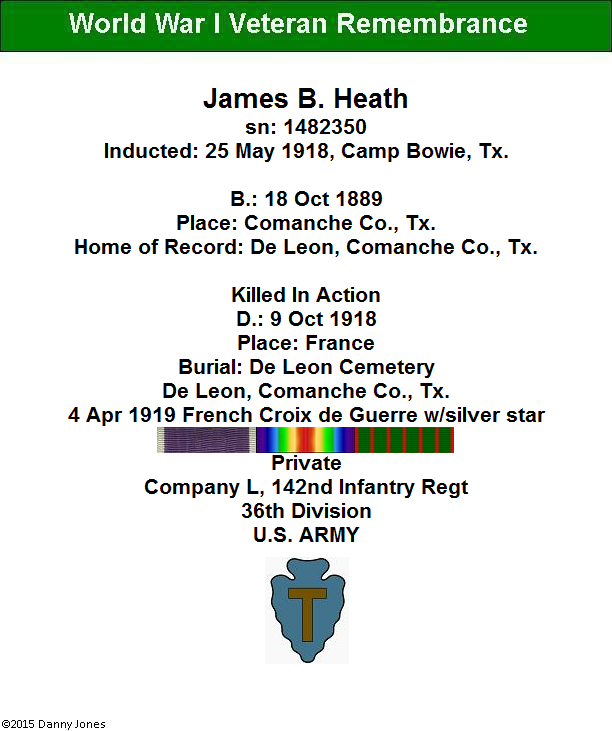
Mr. James Beryl Heath, a married white male living in DeLeon, Comanche County, Texas and he was working for the Trustees of Sabanis School in Comanche County, Texas as of May 24, 1917. James was medium height and medium build with dark color hair and gray eyes and probably a tan complexion. Born in DeLeon, Comanche County, Texas on October 18, 1889 to Henry Clay and Sarah E. Heath, and was raised in Comanche County, Texas. James was reported as living with his parents and siblings in JP5 Comanche County, Texas on both the 1900 and 1910 censuses. James married Miss Sallie E. Robertson on January 15, 1918. James's wife of DeLeon, Texas is listed as next of kin on his Army record.
James was drafted into federal service for the US Army on May 25, 1918 at Camp Bowie, Texas. Recruit Heath was sent to boot camp at Camp Bowie in Fort Worth. Private Heath was assigned to Company L 142nd Infantry Regiment 36th Division at Camp Bowie. The first units of the 36th Division arrived in France May 31, 1918 and the last on August 14, 1918. Private Heath's unit moved to the port of embarkation in Hoboken New Jersey and boarded the transport ship to France on July 18, 1918 for the eleven day voyage to France. The 36th division was stationed at Bar-sur-Aube until September 26, 1918, conducting training with the French Army. The division's Meuse-Argonne operations began October 7, 1918, and it was between Somme-Py and Givry during this battle that James was killed in action October 9, 1918, and buried near the battlefield. His wife was notified.
Private James B. Heath was buried in a temporary grave there in France to be later repatriated to America. The Graves Registration Service of the US Army was James's new unit. The GRS did an awesome job during and after the battles of WW1. James's remains were loaded onto the USAT Wheaton in Antwerp, Belgium on August 6, 1921 and arrived in Hoboken New Jersey August 20, 1921. Then shipped September 17, 1921 by train to DeLeon, Texas arriving September 23, 1921. James Heath was laid to rest in the DeLeon Cemetery at Comanche County, Texas. Survived by his parents and wife. He was awarded the French Croix de Gurre with silver star posthumously on April 4, 1919 for his courage and bravery.


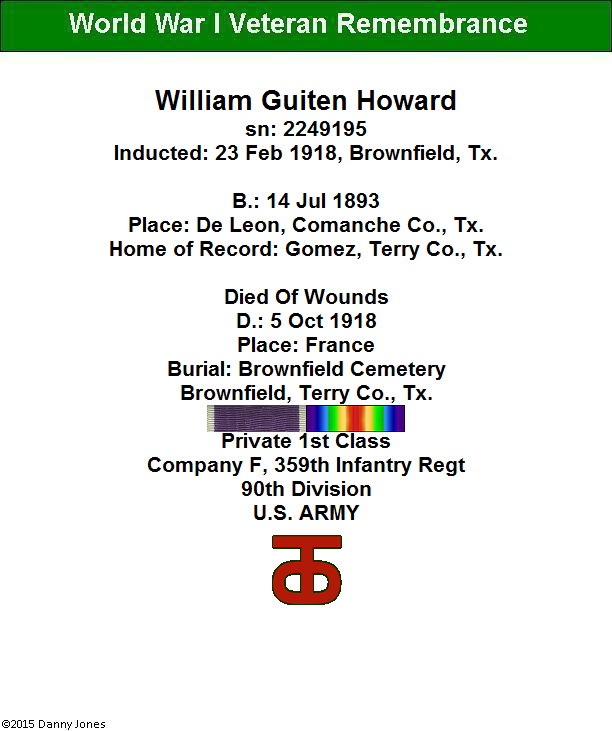
Mr. William Guiten Howard, a single white male living in Gomez, Terry County, Texas and working as a laborer for J. W. Gorden near Brownfield, Texas as of June 5, 1917. William was tall and medium build with light color hair and blue eyes, and probably a very tan complexion from all of the outside work. Born in DeLeon, Comanche County, Texas on July 14, 1893 to Alford and Martha Lucenda Howard, and raised there in Comanche County during his childhood. William was living with his parents and siblings in JP5 Comanche, County, Texas as reported in the 1900 census. I did not find William on the 1910 census. William's father died in 1916. On William's Army record his mother is listed as next of kin and living in Brownfield, Texas.
William was drafted into federal service for the US Army on February 23, 1918 at Brownfield, Texas. He was sent to boot camp at Camp Travis in San Antonio. Private Howard was in Camp Travis for training with the 19th Company 3rd Training Battalion 165th Depot Brigade. Private Howard was reassigned for training with the 32nd Company 8th Training Battalion 165th Depot Brigade. On March 24, 1918 Private Howard was assigned to Company F 359th Infantry Regiment in the 90th Infantry Division. Soon after his assignment they moved out to Camp Mills New York and then to the port of embarkation in Hoboken New Jersey and boarded the transport ship to England on June 20, 1918 for the 11 day voyage to England. Private Howard was promoted to Private 1st Class on July 3, 1918. But then, only a few days after reaching England William's company entered France and spent time training near Rouvres France for six weeks at eight hours per day. On August 19, 1918, the division moved to the vicinity of Toul. This move was scarcely completed when the division was ordered to relieve the 1st Division in the line in the Villers-en-Haye sector north of Toul, which was completed on August 24, 1918.
The 90th division's St. Mihiel operation was September 12-16, 1918. The division remained in line in the Puvenelle sector until October 10, 1918. William was wounded in action on the battlefield during the division's St. Mihiel operations and he died on October 5, 1918 of those wounds recieved in action. His mother was notified.
Private 1st Class William G. Howard was buried in a temporary grave there in France to be later repatriated to Texas. The Graves Registration Service of the US Army was William's new unit. The GRS did an awesome job during and after the battles of WW1. William's remains were loaded onto the USAT Wheaton on June 19, 1921 in Antwerp, Belgium and arrived in Hoboken New Jersey July 2, 1921. Then shipped August 10, 1921 by train to Brownfield, Texas arriving August 26, 1921. William Howard was laid to rest in the Brownfield Cemetery at Brownfield, Terry County, Texas. Survived by his mother.


Mr. Arthur Areilus Hughes, a single white male living in Proctor, Texas and he is working as a farmer for himself as of June 5, 1917. Arthur was a tall medium build man with dark color hair and gray eyes and most likely a tan complexion. Born in Comanche County, Texas on September 26, 1894 to James M. and Mattie B. Hughes and was raised there in Comanche County, Texas. Arthur was found living with his parents and siblings in JP3 Comanche County, Texas on the 1900 census. Arthur was found living with his parents and siblings in Hazeldell, Comanche County, Texas on the 1910 census. On Arthur's Army record, his father of Proctor, Texas is given as next of kin.
Arthur was drafted into federal service for the US Army on September 19, 1917 at Comanche, Texas. He was sent to boot camp at Camp Bowie in Fort Worth for training with the Headquarters Company 143rd Infantry Regiment 36th Division. Private Hughes died in Proctor, Comanche County, Texas of measles and pneumonia on December 15, 1917. His father was notified.


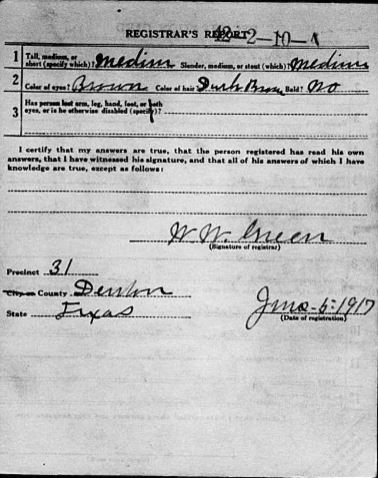
Mr. Charles Lester Hyden, a single white male living in Lewisville, Denton County, Texas and he was farming for himself in Denton County supporting his parents as of June 5, 1917. Charles was of medium height and medium build with dark brown hair and brown eyes and a tan complexion. Born in Proctor, Comanche County, Texas January 19, 1896 to James K. and Rebecca A. (Anders) Hyden, and was raised there in Comanche County, Texas. Charles and his parents and siblings are found in the 1900 and 1910 censuses as living in JP3 Denton County, Texas. Charles's father is listed as next of kin on his Army record, and living in Lewisville, Texas.
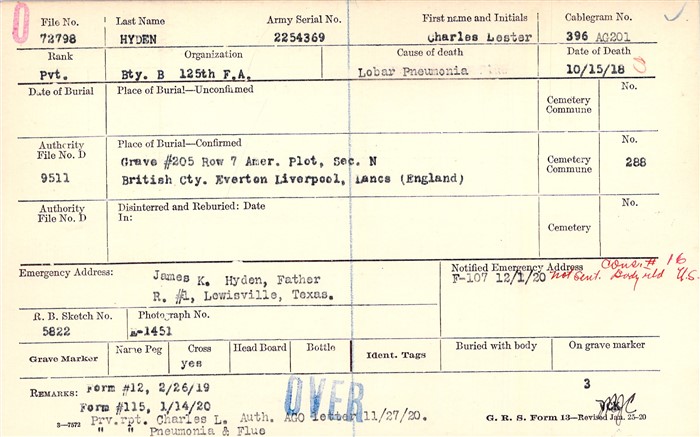
Charles was drafted into federal service for the US Army on July 25, 1918 at Denton, Texas. Recruit Hyden was sent to Camp Travis in San Antonio and assigned to 85th Company 22nd Training Battalion 165th Depot Brigade. Private Hyden was sent to Camp Cody in New Mexico on Aug 15, 1918 and he was assigned to the Casual Detachment 59th Field Artillery Brigade. On September 1, 1918 Private Hyden was assigned to Battery B 125th Field Artillery Regiment 34th Division. The 34th Division remained in training at Camp Cody, New Mexico, until, September 1, 1918. The first units sailed for overseas on September 16, 1918, via England, and Charles's regiment embarked September 24, 1918. Private Hyden got sick with the influenza and died of pneumonia on October 15, 1918 in a hospital at Liverpool, England awaiting embarkation to France. His father was notified in Denton, Texas.
Private Charles L. Hyden was buried in a temporary grave there in England to be later repatriated to Texas. The Graves Registration Service of the US Army was Charles's new unit. The GRS did an awesome job during and after the battles of WW1. Charles's remains were loaded onto the USAT Antigone in Liverpool England on July 26, 1920 and arrived in Hoboken New Jersey on August 7, 1920. Then shipped August 25, 1920 by train to Lewisville, Texas arriving about August 31, 1920. Charles Hyden was laid to rest in the Flower Mound Cemetery at Flower Mound, Denton County, Texas. Survived by his parents.




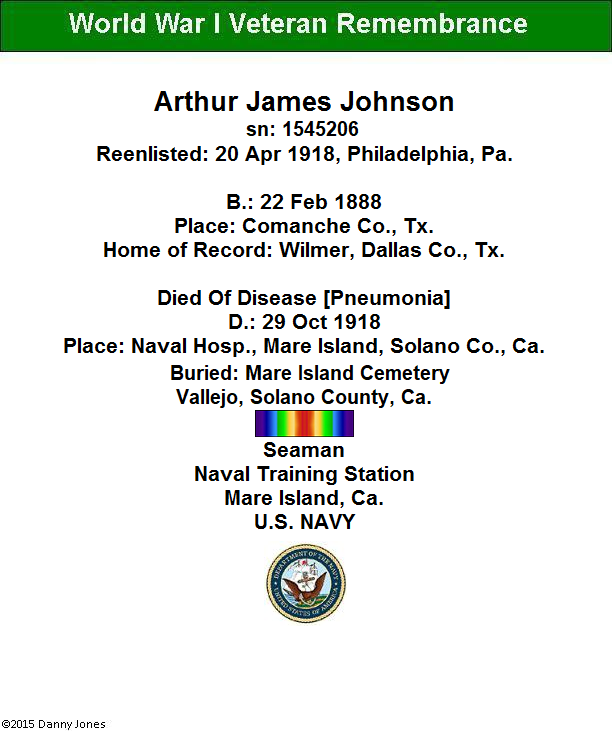
Mr. Arthur James Johnson, a married white male living in Philadelphia, Pennsylvania and he is unemployed as a mariner as of April 13, 1918. Arthur was a medium build man with light brown hair and blue eyes and 5'8" tall. Born in Comanche County, Texas on February 22, 1888 to John F. and Amy E. Johnson and was raised there in Comanche County, Texas. Arthur was found living with his parents and siblings in Comanche County, Texas on the 1900 census. On Arthur's Navy death record, his mother of Wilmer, Texas is given as next of kin. No other records were found of his wife that he noted on the WW1 registration.
![[Navy]](../../images/sealNavy.png) Arthur enlisted into federal service for the US Navy in about 1908-1910. With 8 years previous service as a Navy Seaman, he reenlisted in the Navy at Philadelphia on April 20, 1918. He was stationed at the Mare Island Naval Training Base in Vallejo, California when he died of Pneumonia on October 29, 1918 in the Mare Island Hospital. His next of kin may not have been advised or the next of kin may have chose for him to be buried at the Mare Island Cemetery.
Arthur enlisted into federal service for the US Navy in about 1908-1910. With 8 years previous service as a Navy Seaman, he reenlisted in the Navy at Philadelphia on April 20, 1918. He was stationed at the Mare Island Naval Training Base in Vallejo, California when he died of Pneumonia on October 29, 1918 in the Mare Island Hospital. His next of kin may not have been advised or the next of kin may have chose for him to be buried at the Mare Island Cemetery.


Mr. John Franklin Kennedy, a single white male living in Proctor, Comanche County, Texas and working as a farm laborer for Mr. W. T. Loudermilk as of June 5, 1917. John was medium height and slender with black hair and blue eyes, and probably a very tan complexion from all of the farm work. Born in Langston, Jackson County, Alabama on December 8, 1890 to William D. and Mary A. Kennedy, and raised there in Jackson County, Alabama during his childhood. He was living with his parents and siblings in Langston, Jackson County, Alabama as reported in the 1900 census. John was living with his parents and siblings in JP5 Comanche County, Texas as reported in the 1910 census. On John's Army record his father is listed as next of kin and living in Downing, Texas.
John was drafted into federal service for the US Army on February 23, 1918 at Comanche, Texas. John was sent to boot camp at Camp Travis in San Antonio. John was in Camp Travis for training with the 20th Company 5th Training Battalion 165th Depot Brigade. On March 24, 1918 Private Kennedy was assigned to Company C 359th Infantry Regiment in the 90th Infantry Division. Soon after his assignment they moved out to Camp Mills New York and then to the port of embarkation in Hoboken New Jersey and boarded the transport ship to England on June 20, 1918 for the 11 day voyage to England. But then, only a few days after reaching England John's company entered France and spent time training near Rouvres France for six weeks at eight hours per day.
On August 19, 1918, the division moved to the vicinity of Toul. This move was scarcely completed when the division was ordered to relieve the 1st Division in the line in the Villers-en-Haye sector north of Toul, which was completed on August 24, 1918. The 90th division's St. Mihiel operation was September 12-16, 1918. The division remained in line in the Puvenelle sector until October 10, 1918. John was killed in action on the battlefield September 19, 1918. His father was notified.
Private John F. Kennedy was buried in a temporary grave there in France to be later repatriated to Texas. The Graves Registration Service of the US Army was John's new unit. The GRS did an awesome job during and after the battles of WW1. John's remains were loaded onto the USAT Cambrai in Antwerp Belgium on May 23, 1921 and arrived in Hoboken New Jersey on June 6, 1921. Then shipped June 23, 1921 by train to DeLeon, Texas arriving June 28, 1921. John Kennedy was laid to rest in the Downing Cemetery at Downing, Comanche County, Texas. Survived by his parents.


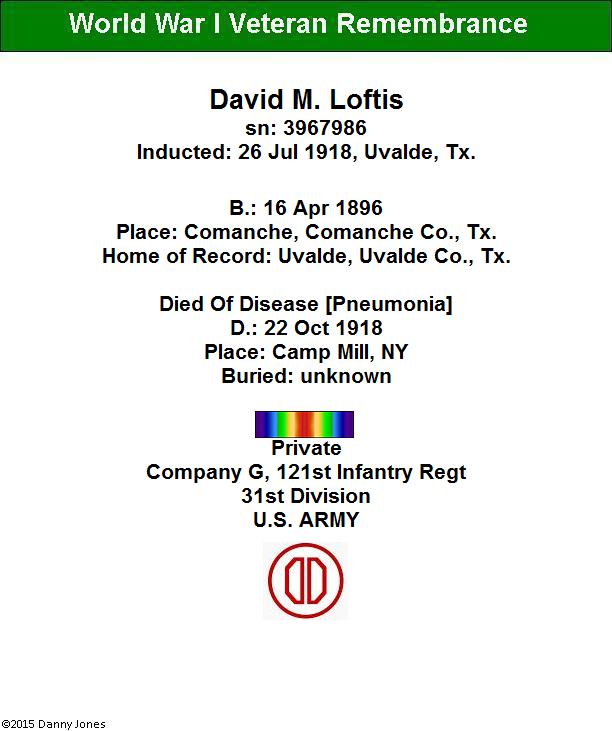
Mr. David Martin Loftis, a single white male living in Uvalde, Texas and working as a farmer for himself as of June 5, 1918. David was a medium height slender man with light brown hair and gray eyes, and probably a very tan complexion from all of the outside work. Born in Comanche, Comanche County, Texas April 16, 1896 to James David and Marilza A. 'Ella' (Davis) Loftis, and raised there in Comanche County. David is reported living with his parents and siblings in JP1 Comanche County, Texas on the 1900 census. David's father died in 1903 at Comanche, Texas. David is reported living with his mother, step-father Robert F. Brewton, and siblings in JP1 Uvalde County, Texas on the 1910 census. David's mother, Mrs. Marilzie Brewton, is listed as next of kin on his Army record, living in Uvalde, Texas.
David was drafted into federal service for the US Army on July 26, 1918 at Uvalde, Texas. Recruit Loftis was sent to boot camp at Camp Travis in San Antonio and assigned to the 78th Company 20th Training Battalion 165th Depot Brigade. David was assigned to the 83rd Company 21st Training Battalion 165th Depot Brigade on August 19, 1918. David was assigned to the 39th Company 21st Training Battalion 165th Depot Brigade on August 27, 1918. Private Loftis was sent to Camp Wheeler in Georgia for training with 31st Division and on September 4, 1918 he was assigned to Company G 121st Infantry Regiment in the 31st Infantry Division. Soon after his assignment they moved out to Camp Mills, New York to prepare for embarkation and the voyage to Scotland. But then, only a month after reaching Camp Mills, David got sick with the influenza and died of pneumonia on October 22, 1918. His mother was notified.
Private David M. Loftis, his burial location not found, but most likely in Uvalde, Texas as his mother and step-father were living there when he died and even through 1920 as found on the census. It is reported that David's father died May 30, 1903 at Comanche, Texas, but his burial is also not found. Survived by his mother and step-father and sister Rachel C. Loftis.


Robert Washington Macon born on 26 August 1895 at Elmore County, Alabama to Elizabeth 'Lizzie' Boatwright (b.1870 Alabama-d.1930 Ganado, Jackson County, Texas) Age 25 and Robert Wilkerson Macon (b.1866 Elmore County, Alabama-d.1950 Cedar Bayou, Harris County, Texas) Age 29.
1900 census Age 4 living with his parents, two sisters and two brothers in Good Hope, Elmore County, Alabama. 1910 census Age 14 living with his parents, two sisters and four brothers in JP7 Eastland County, Texas. (In 1935-1940 census his father was in Comanche County, Texas) He was living in Ganado, Jackson County, Texas when he registered for the draft and stated that he was a single man and working as a farmer. He enlisted in the National Guard at Galveston, Texas on 26 July 1917. He trained with the 2nd and 5th Companies Coast Artillery Corps in the Texas National Guard until 23 January 1918 when he was assigned to the 64th Artillery Regiment.
Private Robert W. Macon 729770 US Army Battery F 64th Artillery Regiment Coast Artillery Corps. He sailed out of New York on 14 July 1918 for France. He died in France on 12 October 1918 of the influenza and pneumonia. He was buried in a temporary grave at Angers, France. His remains were shipped on 31 August 1920 from St. Nazaire, France to Hoboken, New Jersey on USAT Sherman arriving 11 September 1920. Then shipped by rail to R. W. Macon in Hasse, Texas arriving 9 October 1920. Burial was in the Sardis Cemetery in Comanche County, Texas.


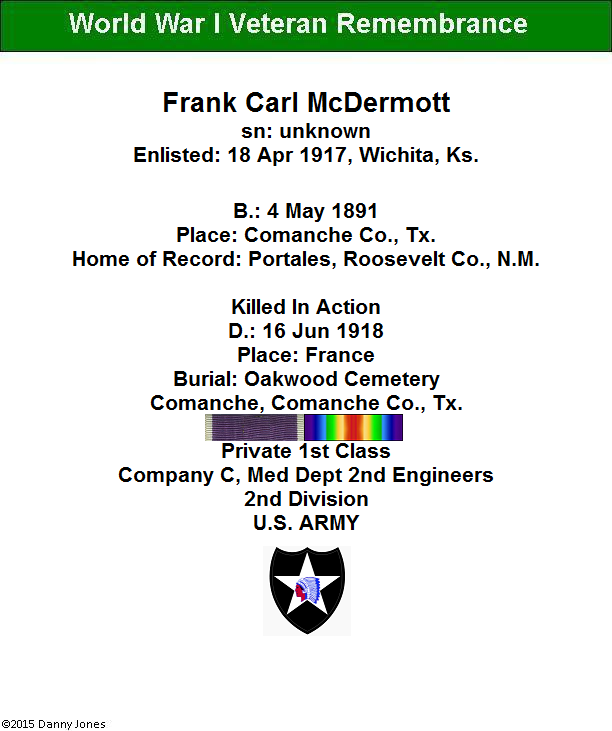
Mr. Frank Carl McDermott, a single white male living in Wichita, Kansas and he was working for the Santa Fe Railway as of April 18, 1917. Frank was born in Comanche County, Texas on May 4, 1891 to Francis M. and Margaret O. McDermott, and was raised in Comanche County, Texas. Frank was reported as living with his parents and siblings in JP1 Comanche County, Texas on the 1900 census. Frank was reported as moving with his parents and siblings to Roosevelt County, New Mexico in 1903. He was not found on the 1910 census, but reports indicate he moved back to Texas for some education, one year of high school and a two year civil engineering course. Becoming ill, he headed back to New Mexico for a time then off to Wichita, Kansas to work for the Santa Fe.
Frank was enlisted into federal service for the US Army on April 18, 1917 at Wichita, Kansas. Recruit McDermott was sent to Fort Baker near El Paso, Texas. Frank was attached to the Medical Department of the 2nd Engineers. In October 1917 Private McDermott was sent to France. After a period of training with the division headquarters at Bourmont, Haute-Marne, from October 26, 1917, to March 16, 1918, the 2nd division entered the Verdun and Toul sectors with headquarters at Sommedieu. Constant patrolling and several enemy raids repulsed. On May 31st moved in to the Chateau-Thierry sector, passing from the 7th A. C. French to the 21st A. C. French as reserve. Went forward about June 1, 1918, to meet a strong enemy attack which had developed on the line west of Chateau-Thierry. The attack of June 3d and 4th was halted June 4th on the line west of Chateau-Thierry and the 2nd division advanced two kilometers in the neighborhood of Vaux and in the Belleau Woods, between June 6th and July 1st.
Evidently a victim of shell shock, as there was no mark on his body, Frank was killed in action on June 16, 1918 while engaged in caring for the wounded in Belleau Woods. It was while a heavy enemy barrage was on, and at the exploding of a shell near him a comrade saw him fall. He was dead when the comrade reached him. Private McDermott had received a gold stripe of service and had been recommended for a Distinguished Service Cross when he met his death.
Private 1st Class Frank C. McDermott was buried in a temporary grave there in France to be later repatriated to Texas. The Graves Registration Service of the US Army was Frank's new unit. The GRS did an awesome job during and after the battles of WW1. Frank's remains were loaded onto the USAT Cantigny in Antwerp Belgium on June 20, 1922 and arrived in Brooklyn, New York on June 30, 1922. Then shipped July 18, 1922 by train to Comanche, Texas arriving July 23, 1922. Frank McDermott was laid to rest in the Oakwood Cemetery at Comanche, Comanche County, Texas under the auspices of the American Legion with full military honors. Survived by his parents.


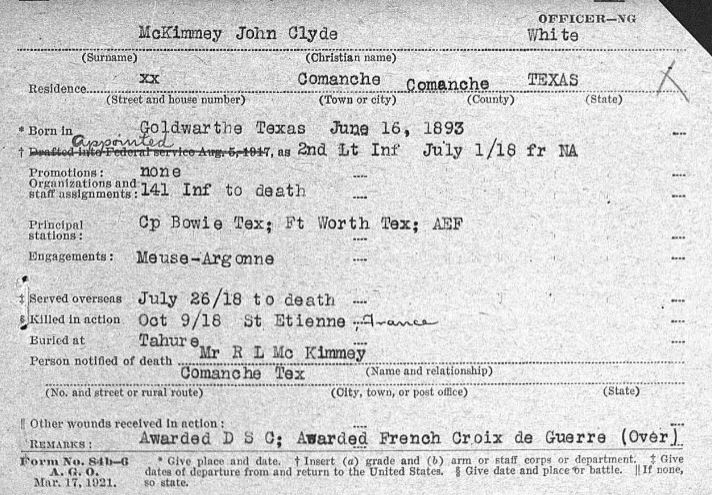
Mr. John Clyde McKimmey, a single white male living in Comanche, Comanche County, Texas and he was a student at Texas A&M College as of June 5, 1917. John was short and medium build with light brown hair and gray eyes and probably a tan complexion. Born in Goldthwaite, Mills County, Texas on June 16, 1893 to John L. and Penelope E. McKimmey, and was raised in Mills County, Texas. John was reported as living with his parents and siblings in JP3 Mills County, Texas in the 1900 census. John's parents died in 1906. John was reported as living with his siblings in JP8 Comanche County, Texas in the 1910 census. He registered for the draft in Comanche County, Texas. John's brother, Mr. R. L. McKimmey of Comanche, Texas, is listed as next of kin on his Army record.
John was enlisted into federal service for the US Army on January 5, 1918 at Camp Bowie, Texas. Recruit McKimmey was sent to boot camp at Camp Bowie in Fort Worth and given the rank of Private 1st Class. John was given assignment to the Company D 143rd Infantry Regiment 36th Infantry Division. On April 23, 1918 PFC McKimmey was promoted to Sergeant. On June 30, 1918 SGT McKimmey was honorably discharged to accept a commission of 2nd Lieutenant in the 3d Battalion 141st Infantry Regiment on July 1, 1918.
The first units of the 36th Division arrived in France May 31, 1918 and the last on August 14, 1918. Lieutenant McKimmey's unit moved to the port of embarkation in Hoboken New Jersey and boarded the transport ship to France on July 26, 1918 for the eleven day voyage to France. The 36th division was stationed at Bar-sur-Aube until September 26, 1918, conducting training with the French Army. The division's Meuse-Argonne operations began October 7, 1918, and it was between Somme-Py and Givry, near St. Etienne during this battle that John was killed in action October 9, 1918, and buried near the battlefield. His brother was notified.
2nd Lieutenant John C. McKimmey was buried in a temporary grave there in France to be later repatriated to America. The Graves Registration Service of the US Army was John's new unit. The GRS did an awesome job during and after the battles of WW1. John's remains were loaded onto the USAT Wheaton in Antwerp, Belgium and departed on August 6, 1921 and arrived in Hoboken New Jersey on August 20, 1921. Then shipped September 17, 1921 by train to Comanche, Texas arriving September 23, 1921. John McKimmey was laid to rest in the Pottsville Cemetery, Hamilton County, Texas. Survived by his siblings. Lieutenant John McKimmey was awarded posthumously the Distinguished Service Cross, and on March 30, 1919 the French Croix de Guerre with palm for his courage in battle.




Mr. Fred McNew, a single white male living in Gustine, Comanche County, Texas and working as a farmer for himself of June 5, 1917. Fred was medium height and stout build with brown hair and blue eyes and a tan complexion. Born in Travis or Burnet County, Texas December 18, 1891 to Benjamin F. and Rachel E. McNew and raised there in Travis or Burnet County, Texas. Fred was found on the 1900 census as living with his parents and siblings in JP2 Comanche County, Texas. Fred was found on the 1910 census as living with his parents and siblings in JP3 Comanche County, Texas. Fred's father of Comanche, Texas is given as next of kin on his Army record.
Fred was drafted into federal service for the US Army on September 19, 1917 at Comanche, Texas. He was sent to boot camp at Camp Bowie in Fort Worth for training with the Company M 143rd Infantry Regiment 36th Division. Private McNew died in the Camp Bowie base hospital of pneumonia on November 29, 1917. His father was notified.
Private Fred McNew's body was sent by train to Comanche, Texas. Fred was laid to rest in the Union Cemetery at Gustine, Comanche County, Texas on November 30, 1917. Survived by his parents.


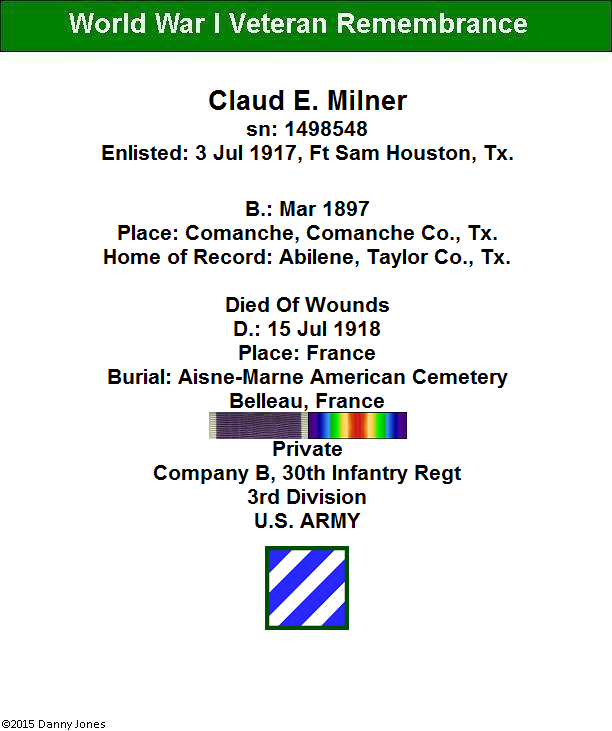
Mr. Claude E. Milner, a single white male living in Abilene, Taylor County, Texas and his employment is unknown of July 3, 1917. Born in Comanche County, Texas about May 1897 and his parents were not found. Claud was not found on either the 1900 or 1910 censuses. Claud's father, J.R.G Milner of Abilene, Texas is given as next of kin on his Army record.
Claud was enlisted into federal service for the US Army on July 3, 1917 at Ft Sam Houston, Texas. He was sent to boot camp at Camp Bowie in Fort Worth for training with the Company A 4th Infantry Texas National Guard. On October 15, 1917 Private Milner was assigned to the Company I 144th Infantry Regiment 36th Division. On March 25, 1918 Claud was assigned to the Camp Bowie Auto Replacement Draft unit and moved out to the port of embarkation in Hoboken, New Jersey and loaded on the transport ship May 3, 1918 for the eleven day voyage to France, then ordered to the St. Aignan training area with the 41st Division. Claud was assigned to the Company B 163rd Infantry Regiment 41st Division on June 28, 1918, but then six days later he was assigned to Company B 30th Infantry Regiment 3rd Division on July 4, 1918. The entire 3rd Division entered the Chateau-Thierry sector in June 1918. On July 15, 1918 they met the Germans who crossed the Marne, and this is when Private Milner was wounded in action and he died of the wounds received and was buried near the battlefield. His father, John R. Graves Milner of San Angelo, Texas, was notified.
Private Claude E. Milner was buried in a temporary grave there in France to be later reinterred on October 23, 1922 in the Aisne-Marne↘ American Cemetery at Belleau, France. The GRS did an awesome job during and after the battles of WW1. Survived by his parents.


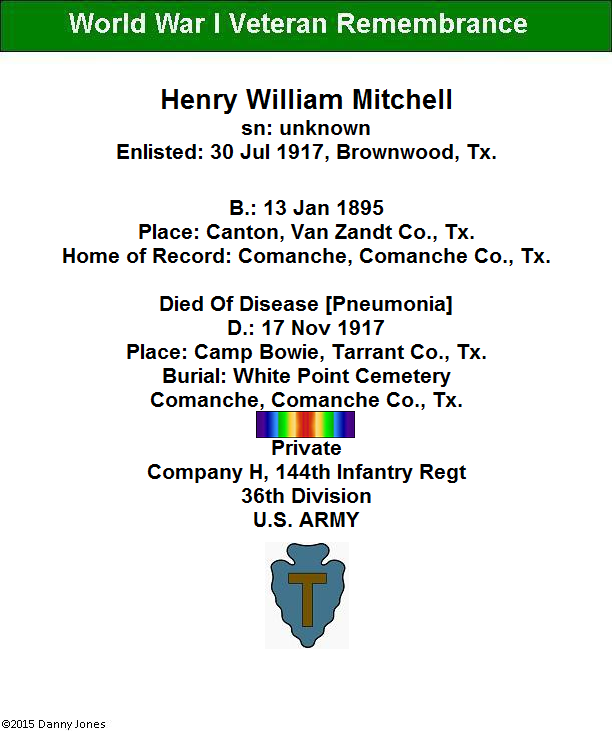
Mr. Henry William Mitchell, a single white male living in Blanket, Brown County, Texas and working as a farm laborer for Mr. John Roberts near Sidney, Texas as of June 5, 1917 and registered for draft in Comanche County, Texas. Henry was of medium height and medium build with black hair and brown eyes, and probably a very tan complexion from all of the farm work. Born in Canton, Van Zandt County on January 13, 1895 to Andrew J. and Mary Eliza Mitchell, and he was raised there in Van Zandt County. He was reported living with his parents and siblings in JP1 Van Zandt County, Texas on the 1900 census. He was reported living with his parents and siblings in JP1 Comanche County, Texas on the 1910 census. Henry's father is listed as the next of kin on his Army record.
Henry was enlisted into federal service for the US Army on July 30, 1917 at Brownwood, Texas. Recruit Mitchell was sent to boot camp at Camp Bowie in Fort Worth, Texas. Private Mitchell was in Camp Bowie for training with the Company E 6th Infantry Texas National Guard. His unit was then renamed for national service to Company H 144th Infantry Regiment of the 36th Infantry Division. Henry was there only a few months when he got sick, probably the influenza, and died of pneumonia on November 17, 1917. His father was notified in Comanche, Texas.
Private Henry W. Mitchell was laid to rest in the White Point Cemetery at Comanche County, Texas on November 17, 1917. Survived by his parents.


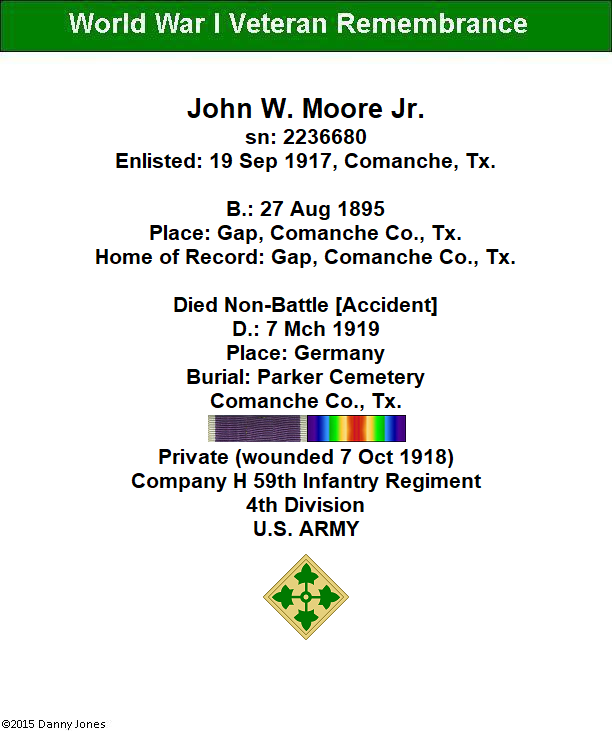
Mr. John William Moore, Jr., a single white male living in Gap, Comanche County, Texas and working as a farmer for himself near Gap, Texas of June 5, 1917. John was of medium height and slender build with brown hair and brown eyes and a tan complexion. Born in Gap, Comanche County, Texas on August 27, 1895 to John W. and Eugene P. Moore, and raised there in Comanche County. John's father died in 1898. John is reported living with his mother, Eugena and at her brother Bob Parker's residence, and siblings in JP6 Comanche County, Texas on the 1900 census. John is reported living with his mother, Eugene and at her mother Martha E. Parker's residence, and a sibling in JP6 Comanche County, Texas on the 1910 census. John's mother is listed on his Army record as next of kin living at Gap, Texas.
John was enlisted into active federal service for the US Army on September 19, 1917 at Comanche, Texas. John Moore was sent to boot camp at Camp Travis in San Antonio. John was in Camp Travis for training with the Company D 15th Training Battalion 165th Depot Brigade. On October 1, 1917, John was assigned to the Company A 315th Engineer Regiment 90th Infantry Division at Camp Travis. On March 14, 1918, Private Mitchell was transferred to the Company H 59th Infantry Regiment 4th Division in Camp Greene, North Carolina. John's regiment moved out to Camp Mills New York and then to the port of embarkation in Hoboken New Jersey and boarded the transport ship to France on May 5, 1918 for the eleven day voyage to France. John's company entered France and spent time training near Samer France with the British. On June 9, 1918, the division moved to the Meaux and vicinity and on June 15th moved to LaFerte, being at the disposal of the 164th French Infantry Division.
On September 7th, troops of the 59th Infantry went into the line the Toul sector southeast of Verdun. The 59th Infantry was relieved September 15th and the entire division moved to woods near Lennes on night September 19th-20th. The division, as part of 3d Corps, attacked on the first day in the Meuse-Argonne offensive, September 26, 1918 , advancing six and a half kilometers the first day, and continued in this offensive until October 19th, John was wounded in action on October 7th during Argonne. On October 20th the division was assigned to the 2nd Army; started to move to Vignot and Lucey areas on October 21st. On November 4th the division was assigned again to the 1st Army and started moving to Blercourt, November 6th, but was reassigned to the 2d Army on November 8th. The 4th division returned to Void November 9th, attached to the 4th Corps. After signing of the armistice, the division concentrated around Bourcq November 13th. Began its march into Germany November 20th, under the 3d Army and on December 16th the division was occupying the Kreises of Adenau and Cochem, Province of the Rhine, as its permanent area of occupation. While in Germany, John died on March 7, 1919 of the traumatic injuries received in an accident where his foot was amputated by a train. His mother was notified in Gap, Texas.
Private John W. Moore, Jr. was buried in a temporary grave there in Germany to be later repatriated to America. The Graves Registration Service of the US Army was John's new unit. The GRS did an awesome job during and after the battles of WW1. John's remains were loaded onto the USAT Princess Matoika in Antwerp Belgium on August 18, 1920 and arrived in Hoboken New Jersey on September 5, 1920. Then shipped September 18, 1920 by train to Comanche Texas arriving September 22, 1920. John Moore was laid to rest in the Parker Cemetery at Johnson County, Texas. Survived by his mother.


Mr. Thomas Franklin Munn, a single white male living in Democrat, Comanche County, Texas and working as a farmer for his mother as of June 5, 1917. Thomas was of medium height and medium build with black hair and brown eyes. Born in Comanche County, Texas on August 20, 1891 to Thomas J. and Serena J. Munn, and raised there in Comanche County, Texas. Thomas and parents and siblings are found living in JP5 Comanche County, Texas the 1900 census. Thomas and parents and siblings are found living in Crane County, Texas the 1910 census. Thomas's father died in 1917. Thomas's mother is listed on his Army record as next of kin living in Staff, Eastland County, Texas.
Thomas was drafted into active federal service for the US Army on May 25, 1918 at Comanche, Texas. Thomas Munn was sent to infantry training at Camp Travis, San Antonio, Texas assigned to the 54th Company 15th Training Battalion 165th Depot Brigade. On June 25, 1918 Private Munn was assigned to the Company G 64th Infantry Regiment in the 7th Infantry Division at Camp MacArthur, Waco. Thomas's regiment moved out to the port of embarkation in Hoboken New Jersey and boarded the transport ship to France on August 26, 1918 for the eleven day voyage to France. Only a few days after reaching France Thomas's company entered the 15th training area near Ancy-le-Franc.
On September 30, 1918, the division moved to the vicinity of Toul, more training and equipping. This move was scarcely completed when the division was ordered to relieve the 90th Division in the line in the Puvenelle sector north of Toul, which was completed on October 11, 1918. Private Munn died of pneumonia on October 9, 1918. His mother was notified.
Private Thomas F. Munn was buried in a temporary grave there in France to be later repatriated to America. The Graves Registration Service of the US Army was Thomas's new unit. The GRS did an awesome job during and after the battles of WW1. Thomas's remains were loaded onto the USAT Wheaton on May 3, 1921 in Antwerp, Belgium and arrived in Hoboken, New Jersey May 18, 1921. Then shipped June 10, 1921 by train to Comanche, Texas arriving June 15, 1921. Thomas Munn was laid to rest in the Oakwood Cemetery at Comanche, Comanche County, Texas. Survived by his mother.


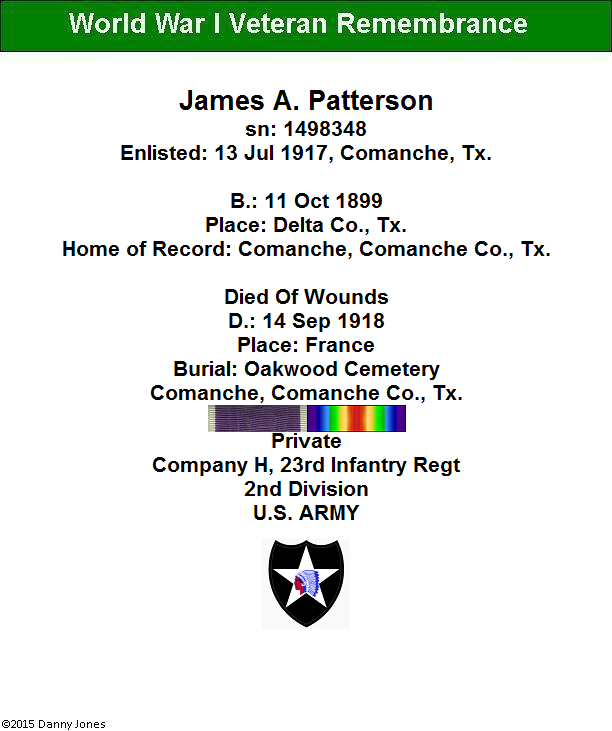
Mr. James A. Patterson, a single white male living in Comanche, Comanche County, Texas and his employment is unknown as of July 13, 1917. James did not need to register in the draft. Born in Delta County, Texas on October 11, 1899 to James E. (1860-) and Permelia Ann (Skidmore) (1871-1937) Patterson, and was raised in Delta County, Texas. James was reported as living with his parents and siblings in JP4 Delta County, Texas on the 1900 census. James was reported as living with his parents and siblings in Comanche, Comanche County, Texas on the 1910 census. James's mother, Melia Patterson of Comanche, Texas is listed as next of kin on his Army record.
James was enlisted into federal service for the US Army on July 13, 1917 at Comanche, Texas. Recruit Patterson was sent to boot camp at Camp Bowie in Fort Worth assigned to Company E 6th Infantry Texas National Guard. On October 15, 1917 Private Patterson's unit was renamed Company H 144th Infantry Regiment 36th Division. On July 4th the 36th Division left for Camp Mills, L.I. Sailed from Hoboken, N.J., on July 18, 1918 for the eleven day voyage to France. Arriving at Brest, St. Nazaire, Le Havre and Bordeaux, beginning July 30th, thence proceeding to the 13th training area in vicinity of Bar-sur-Aube.
On August 21, 1918, Private Patterson was transferred to the Company H 23rd Infantry Regiment 2nd Division. The division entered the line on the St. Mihiel salient, September 9th, withdrawing September 16th, after having advanced approximately nine kilometers. James was wounded in action during the St. Mihiel offensive and died of the wounds on September 14, 1918, and buried near the battlefield. His mother was notified.
Private James A. Patterson was buried in a temporary grave there in France to be later repatriated to America. The Graves Registration Service of the US Army was James's new unit. The GRS did an awesome job during and after the battles of WW1. James's remains were loaded onto the USAT Cambrai in Antwerp Belgium on May 23, 1921 and arrived in Hoboken New Jersey on June 6, 1921. Then shipped June 23, 1921 by train to Comanche, Texas arriving June 29, 1921. James Patterson was laid to rest in the Oakwood Cemetery at Comanche, Comanche County, Texas under the auspices of the American Legion. Survived by his mother.


Mr. Floyd T. Rice, a single white male living in Lamesa, Dawson County, Texas and working as a farmer for himself as of June 5, 1917. Floyd was medium height and medium build with dark color hair and gray eyes, and probably a very tan complexion from all of the farm work. Born in Sipe Springs, Comanche County, Texas on November 2, 1893 to Warren A. and Blanche V. Rice, and raised there in Comanche County during his childhood. Floyd was living with his parents and siblings in Cuthbert, Mitchell County, Texas as reported in the 1900 census and JP1 Mitchell County in the 1910 census. On Floyd's Army record his father is listed as next of kin and living in Lamesa, Texas.
Floyd was drafted into federal service for the US Army on February 23, 1918 at Lamesa, Texas. He was sent to boot camp at Camp Travis in San Antonio. Private Rice was in Camp Travis for training with the 19th Company 5th Training Battalion 165th Depot Brigade. On March 24, 1918 Private Rice was assigned to Company B 359th Infantry Regiment in the 90th Infantry Division. Soon after his assignment they moved out to Camp Mills New York and then to the port of embarkation in Hoboken New Jersey and boarded the transport ship to England on June 20, 1918 for the eleven day voyage to England. But then, only a few days after reaching England Floyd's company entered France and spent time training near Rouvres France for six weeks at eight hours per day. On August 19, 1918, the division moved to the vicinity of Toul. This move was scarcely completed when the division was ordered to relieve the 1st Division in the line in the Villers-en-Haye sector north of Toul, which was completed on August 24, 1918.
The 90th division's St. Mihiel operation was September 12-16, 1918. The division remained in line in the Puvenelle sector until October 10, 1918. The 90th Division's Meuse-Argonne operations ran October 13 to November 11, 1918. Floyd was involved in the action on the battlefield during the division's Meuse-Argonne operations and he was killed in action on November 3, 1918. His father was notified.
Private Floyd T. Rice was buried in a temporary grave there in France to be later repatriated to Texas. The Graves Registration Service of the US Army was Floyd's new unit. The GRS did an awesome job during and after the battles of WW1. Floyd's remains were loaded onto the USAT Cantigny in Antwerp Belgium on June 20, 1922 and arrived in Brooklyn, New York on June 30, 1922. Then shipped July 8, 1922 by train to Lamesa, Texas arriving July 12, 1922. Floyd Rice was laid to rest in the Dawson County Cemetery at Lamesa, Dawson County, Texas. Survived by his parents.


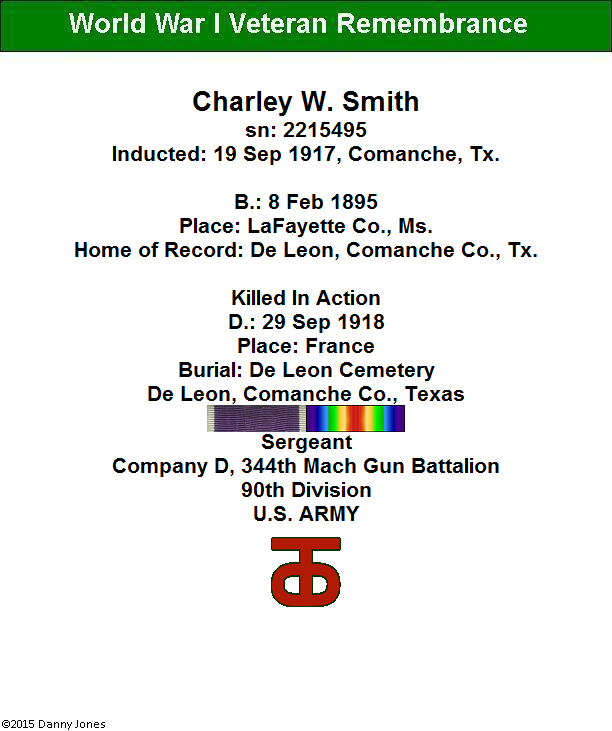
Mr. Charley Webster Smith, a single white male living in DeLeon, Comanche County, Texas and working as a tinsmith and general repairman for himself as of June 5, 1917. Charley was short and stout with black hair and blue eyes, and probably a very tan complexion from all of the outside work. Born in Lafayette County, Mississippi on February 8, 1895 to Joseph J. and Mickey Ann Smith, and raised there in Lafayette County, Mississippi during his childhood. Charley was living with his parents and siblings in JP5 Comanche County, Texas as reported in the 1900 census. Charley was living with his parents and siblings in DeLeon, Comanche County, Texas as reported in the 1910 census. On Charley's Army record his mother is listed as next of kin and living in DeLeon, Texas.
Charley was drafted into federal service for the US Army on September 19, 1917 at Comanche, Texas. Charley was sent to boot camp at Camp Travis in San Antonio. Private Smith was in Camp Travis for training with the Company D 343rd Machine Gun Battalion 90th Division. Charley was promoted to Corporal on November 6, 1917. On March 7, 1918 Corporal Smith was assigned to Company D 344th Machine Gun Battalion in the 90th Infantry Division. Charley was promoted to Sergeant on April 25, 1918. Soon after his assignment they moved out to Camp Mills New York and then to the port of embarkation in Hoboken New Jersey and boarded the transport ship to England on June 21, 1918 for the eleven day voyage to England. But then, only a few days after reaching England Charley's battalion entered France and spent time training near Rouvres France for six weeks at eight hours per day.
On August 19, 1918, the division moved to the vicinity of Toul. This move was scarcely completed when the division was ordered to relieve the 1st Division in the line in the Villers-en-Haye sector north of Toul, which was completed on August 24, 1918. The 90th division's St. Mihiel operation was September 12-16, 1918. The division remained in line in the Puvenelle sector until October 10, 1918. Charley was killed in action on the battlefield September 29, 1918. His mother was notified.
Sergeant Charley W. Smith was buried in a temporary grave there in France to be later repatriated to Texas. The Graves Registration Service of the US Army was Charley's new unit. The GRS did an awesome job during and after the battles of WW1. Charley's remains were loaded onto the USAT Cambrai in Antwerp Belgium on May 23, 1921 and arrived in Hoboken New Jersey on June 6, 1921. Then shipped June 23, 1921 by train to DeLeon, Texas arriving June 29, 1921. Charley Smith was laid to rest in the DeLeon Cemetery at DeLeon, Comanche County, Texas. Survived by his parents.


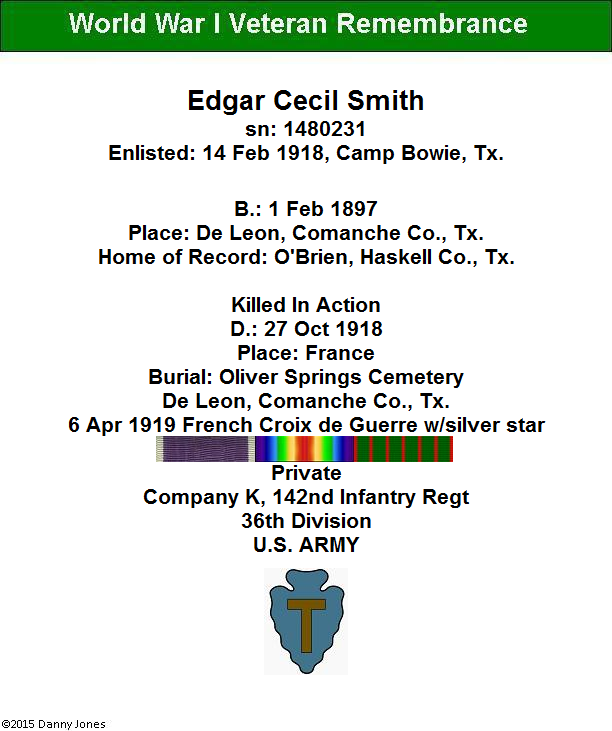
Mr. Edgar Cecil Smith, a single white male living in O'Brien, Haskell County, Texas and his employment is unknown as of February 14, 1918. Edgar's draft card was not found, if he registered. Born in DeLeon, Comanche County, Texas on February 1, 1897 to George W. and Amanda M. Smith, and was raised in Comanche County, Texas. Edgar's mother died in 1897, twenty days after he was born. Edgar was reported as living with his father and step-mother and siblings in JP5 Comanche County, Texas on the 1900 census. Edgar was reported as living with his brother George W. and siblings in JP5 Comanche County, Texas on the 1910 census. Edgar's uncle, Jordan D. Smith of O'Brien, Texas, is listed as next of kin on his Army record.
Edgar was drafted into federal service for the US Army on February 14, 1918 at Camp Bowie, Texas. Recruit Smith was sent to boot camp at Camp Bowie in Fort Worth. Private Smith was assigned to Company K 142nd Infantry Regiment 36th Division at Camp Bowie. The first units of the 36th Division arrived in France May 31, 1918 and the last on August 14, 1918. Private Smith's unit moved to the port of embarkation in Hoboken New Jersey and boarded the transport ship to France on July 18, 1918 for the eleven day voyage to France. The 36th division was stationed at Bar-sur-Aube until September 26, 1918, conducting training with the French Army. The division's Meuse-Argonne operations began October 7, 1918, and it was between Somme-Py and Givry during this battle that Edgar was killed in action October 27, 1918, and buried near the battlefield. His uncle was notified.
Private Edgar C. Smith was buried in a temporary grave there in France to be later repatriated to America. The Graves Registration Service of the US Army was Edgar's new unit. The GRS did an awesome job during and after the battles of WW1. Edgar's remains were loaded onto the USAT Wheaton in Antwerp, Belgium on September 19, 1921 and arrived in Hoboken New Jersey October 3, 1921. Then shipped October 7, 1921 by train to DeLeon, Texas arriving October 15, 1921. Edgar Smith was laid to rest in the Oliver Springs Cemetery at Comanche County, Texas. He was awarded the French Croix de Gurre with silver star posthumasly on April 6, 1919 for his courage and bravery.


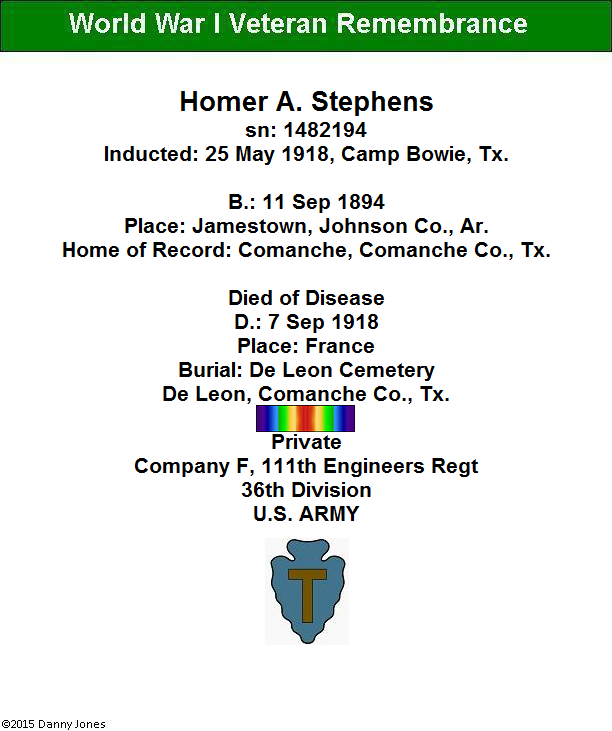
Mr. Homer Alfred Stephens, a single white male living in Comanche, Comanche County, Texas and working as a farmer for himself as of June 5, 1917. Homer was medium height and stout build with red hair and blue eyes and a tan complexion. Born in Jamestown, Johnson County, Arkansas on September 11, 1894 to Clinton M. and Mary C. Stephens, and was raised in Johnson County, Arkansas. Homer was reported as living with his father and siblings in JP1 Comanche County, Texas on the 1910 census. Homer married Miss Laura Mae Griffith in 1918. Homer's mother, Mrs. Mary C. Stephens of Comanche, Texas, is listed as next of kin on his Army record.
Homer was drafted into federal service for the US Army on May 25, 1918 at Camp Bowie, Texas. Recruit Stephens was sent to boot camp at Camp Bowie in Fort Worth. Private Stephens was assigned to Company F 111th Engineer Regiment 36th Division at Camp Bowie. The first units of the 36th Division arrived in France May 31, 1918 and the last on August 14, 1918. Private Stephens's unit moved to the port of embarkation in Hoboken New Jersey and boarded the transport ship to France on July 18, 1918 for the eleven day voyage to France. The 36th division was stationed at Bar-sur-Aube until September 26, 1918, conducting training with the French Army. Homer got sick and died of pneumonia on September 7, 1918. His mother was notified.
Private Homer A. Stephens was buried in a temporary grave there in France to be later repatriated to America. The Graves Registration Service of the US Army was Homer's new unit. The GRS did an awesome job during and after the battles of WW1. Homer's remains were loaded onto the USAT Wheaton in Antwerp, Belgium on April 26, 1921 and arrived in Hoboken New Jersey May 18, 1921. Then shipped June 17, 1921 by train to DeLeon, Texas arriving June 23, 1921. Homer Stephens was laid to rest in the DeLeon Cemetery at DeLeon, Comanche County, Texas.


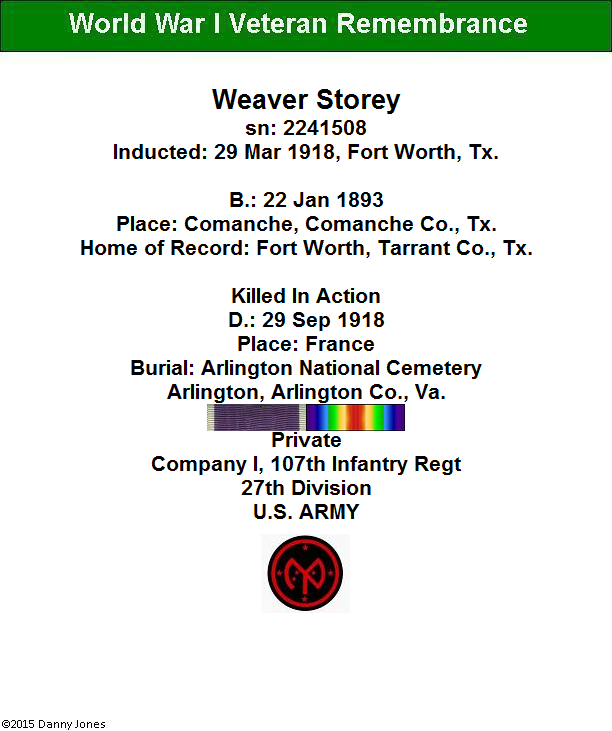
Mr. Weaver J. Storey, a single white male living in Tarrant County, Texas and working as a farm laborer for Mr. W. K. Francis on Burleson Road as of June 5, 1917. Weaver was tall and slender with light color hair and blue eyes with a tan complexion. Born in Comanche County, Texas on January 22, 1893 to James and Mary J. Storey, and raised in Comanche County, Texas. Weaver's father died before 1900 census was taken. Weaver is reported living with his mother and siblings in JP3 Comanche County, Texas on the 1900 census. Weaver is reported living with his mother and siblings in JP2 Comanche County, Texas on the 1910 census. Weaver's mother died in 1916. Weaver's brother, John C. Storey is listed on his Army record as next of kin living in Fort Worth, Texas.
Weaver was drafted into federal service for the US Army on March 29, 1918 at Fort Worth, Texas. Recruit Storey was sent boot camp at Camp Travis in San Antonio. Weaver was in Camp Travis for training with the 27th Company 7th Training Battalion 165th Depot Brigade. Private Storey was transferred to 5th Company 2nd Replacement Battalion 1st Replacement Regiment at Camp Gordon, Georgia on April 22, 1918. He was transferred to Recruit Detachment 27th Division at Camp Stuart, Virginia on May 19, 1918. On May 25, 1918 Private Storey was assigned to Company A 2nd Corps Replacement Battalion, moved to the port of embarkation in Newport News, Virginia and boarded the transport ship to France on June 6, 1918 for the eleven day voyage to France.
Weaver's company entered France and spent time training. Weaver was assigned to the Company I 107th Infantry Regiment 27th Division and then entered the line with the British units opposite Mt. Kemmel. On August 20, 1918, the division moved to the Dickebush sector, Belgium which was occupied next day. On August 31st the division was a front line division in the attack on Vierstandt Ridge, the 30th Division on its left, 34th British Division on its right. As part of the 2d Corps (U.S.) 4th British Army, the division was in action near Bony, September 24th to October 1st. On October 12th it again entered the line in the St. Soupiet sector crossing the Seille River in the attack on Jonc de Mer Ridge. During the Ypres-Lys operations Weaver Storey was killed in action on September 29, 1918. His brother was notified.
Private Weaver J. Storey was buried in a temporary grave there in France to be later repatriated to America. The Graves Registration Service of the US Army was Weaver's new unit. The GRS did an awesome job during and after the battles of WW1. Weaver's remains were loaded onto the USAT Cambrai in Calais, France on March 21, 1921 and arrived in Hoboken New Jersey April 3, 1921. Then shipped April 11, 1921 by train to Arlington, Virginia arriving April 12, 1921. Weaver Storey was laid to rest in the Arlington National Cemetery, Arlington, Arlington County, Virginia on April 21, 1921.


Mr. Hyman B. Todd, a single white male living in Comanche, Comanche County, Texas and his employment is unknown as of April 1, 1918. Hyman's draft card was not found. Born in Comanche County, Texas on February 9, 1897 to Sam B. and Laura E. Todd, and was raised in Comanche County, Texas. Hyman was reported as living with his parents and a sister in JP1 Comanche, Comanche County, Texas on the 1900 census. Hyman was reported as living with his parents and siblings in Comanche, Comanche County, Texas on the 1910 census. Hyman's father, Mr. Sam B. Todd of Comanche, Texas, is listed as next of kin on his Army record.
Hyman was enlisted into federal service for the US Army on April 1, 1918 at Ft Sam Houston, Texas. Recruit Todd was sent to boot camp at Ft Sam Houston in San Antonio. Private Todd was assigned to Bakery Company 4 Quartermaster Corps. Hyman was made Cook in the 322nd Bakery Company Quartermaster Corps. Private Todd's unit moved to the port of embarkation in Hoboken New Jersey and boarded the transport ship to France on June 15, 1918 for the eleven day voyage to France. Hyman was working at an Army bakery near Dijon, France when he got sick and died of pneumonia on November 13, 1918. His father was notified.
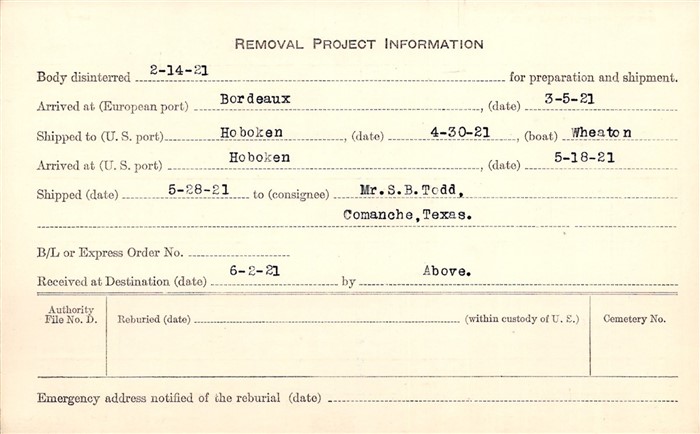
Cook Hyman B. Todd was buried in a temporary grave there in France to be later repatriated to America. The Graves Registration Service of the US Army was Hyman's new unit. The GRS did an awesome job during and after the battles of WW1. Hyman's remains were loaded onto the USAT Wheaton in Bordeaux, France on April 30, 1921 and arrived in Hoboken New Jersey May 18, 1921. Then shipped May 28, 1921 by train to Comanche, Texas arriving June 2, 1921. Hyman Todd was laid to rest in the Oakwood Cemetery at Comanche, Comanche County, Texas. Survived by his parents.



Mr. James Adam Turnbow, a single white male living in DeLeon, Comanche County, Texas and working as a farm laborer for M. E. Duke 3.5 miles north of DeLeon as of June 5, 1917. James was of medium height and medium build and had light brown hair and blue eyes with a tan complexion. Born in Pottawatomie County, Oklahoma on January 25, 1891 to James B. and Rachel Catherine Turnbow, and was raised in Pottawatomie County, Oklahoma. James was reported as living with his parents and two sisters in Brinton, Pottawatomie County, Oklahoma on the 1900 census. James was reported as living with his parents and siblings in Jp1 Val Verde County, Texas on the 1910 census. James's mother, Mrs. Rachel C. Turnbow of Bennington, Oklahoma, is listed as next of kin on his Army record.
James was drafted into federal service for the US Army on March 29, 1918 at Comanche, Texas. Recruit Turnbow was sent to boot camp at Camp Travis in San Antonio. Private Turnbow was assigned to 11th Company 3rd Training Battalion 165th Depot Brigade. On April 10, 1918, James was assigned to the 32nd Company 8th Training Battalion 165th Depot Brigade. On April 23, 1918 James was transferred to 8th Company 1st Replacement Regiment Camp Gordon, Georgia. On May 19, 1918, Private Turnbow was unassigned in the 27th Division until June 6, 1918 when assigned 5th Provisional Company 105th Field Artillery Regiment. Private Turnbow's unit moved to the port of embarkation in Newport News, Virginia and boarded the transport ship to France on June 15, 1918 for the eleven day voyage to France.
Arriving in France, June 26, 1918, it was ordered to a training area and later entered the line with the British units opposite Mt. Kemmel. On July 8, 1918, James was assigned to 4th Battery Field Artillery Replacement Regiment until July 10th then assigned to Battery E 148th Field Artillery Regiment in the 41st Infantry Division. The 66th Field Artillery Brigade served as Corps and Army Artillery throughout its service in France and was engaged in active operations in the Marne-Aisne, St. Mihiel and Meuse-Argonne offensive. James got sick and died of pneumonia on December 24, 1918 near Vittel, Vosages, France. His mother was notified.
Private James A. Turnbow was buried in a temporary grave there in France to be later repatriated to America. The Graves Registration Service of the US Army was James's new unit. The GRS did an awesome job during and after the battles of WW1. James's remains were loaded onto the USAT Wheaton in Cherbourg, France on April 30, 1921 and arrived in Hoboken New Jersey May 18, 1921. Then shipped June 3, 1921 by train to Bennington, Oklahoma arriving June 8, 1921. James Turnbow was laid to rest in the Old Bennington Presbyterian Church Cemetery at Bennington, Bryan County, Oklahoma. Survived by his parents.


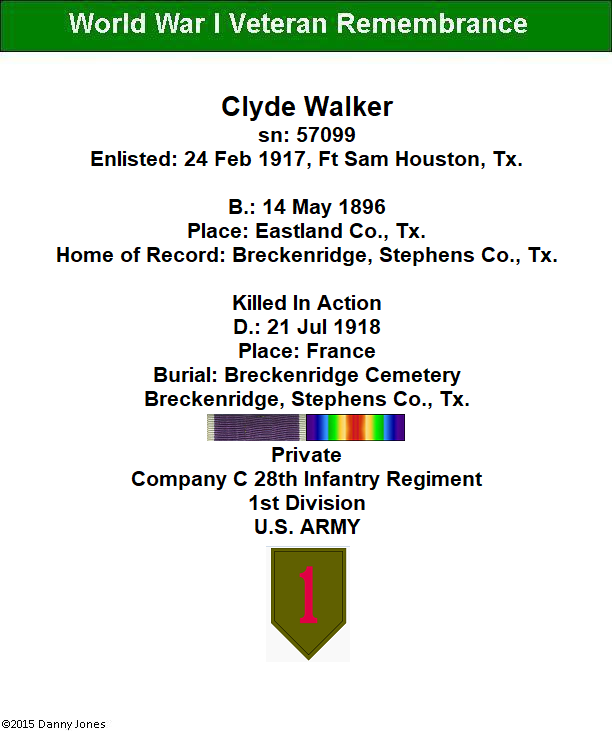
Mr. Clyde Walker, a single white male living in Breckenridge, Stephens County, Texas and likely working as farm laborer for his father as of February 24, 1917. Clyde was born in Eastland County, May 14, 1896 to Samuel J. and Mabel 'May' Walker, and raised there in Eastland County. Clyde is reported as living with his parents and siblings in JP5 Eastland County, Texas in the 1900 census. Clyde is reported as living with his parents and siblings in DeLeon, Comanche County, Texas in the 1910 census. Clyde's father is listed on his Army record as next of kin living in Woodson, Texas.
Clyde enlisted into federal service for the US Army on February 24, 1917 at Ft Sam Houston, Texas. Recruit Walker was trained up at Ft Sam Houston in San Antonio, and then on March 8, 1917 Private Walker was sent to Ft McIntosh in Webb County, Texas for training with 37th Infantry Regiment patrolling the Mexican border and he was assigned to Company C 37th Infantry Regiment. Soon after America entered the World War on April 6, 1917, his unit was assigned to the 1st Infantry Division. Private Walker was assigned to Company C 28th Infantry Regiment on May 30, 1917 and they moved out to the port of embarkation in New Jersey and boarded the transport ship to France on June 12, 1917 for the eleven day voyage to France.
The First Division being the first American division to enter France, and first to fire a shot at the Germans, for training they were initially under the tactical command of the French Army. Private Walker fought in the Luneville sector October 21, 1917 to November 20, 1917, the Ansauville sector January 15, 1918 to April 3, 1918. Then, only a few days of quiet before the division entered the Cantigny sector on April 25, 1918. The Cantigny operation was carried out the morning of May 28th, the division advancing the line three to six hundred yards on a twenty-two-hundred yard front. Division was relieved July 7, 1918. Entered the line the night of July 17, 1918, for the Soissons operation, approximately fifteen kilometers southwest of Soissons. The fighting was severe throughout the attack, especially July 20th and 21st. During this battle Private Walker was killed in action on July 21, 1918. Clyde's father, Sam Walker was notified in Woodson, Throckmorton County, Texas.
Private Clyde Walker was buried in a temporary grave there in France to be later repatriated to Texas. The Graves Registration Service of the US Army was Clyde's new unit. The GRS did an awesome job during and after the battles of WW1. Clyde's remains were loaded onto the USAT Somme in Antwerp, Belgium on April 22, 1921 and arrived in Hoboken New Jersey May 6, 1921. Then shipped May 13, 1921 by train to Breckenridge, Texas arriving May 17, 1921. Clyde Walker was laid to rest in the Breckenridge Cemetery at Breckenridge, Stephens County, Texas. Survived by his parents.


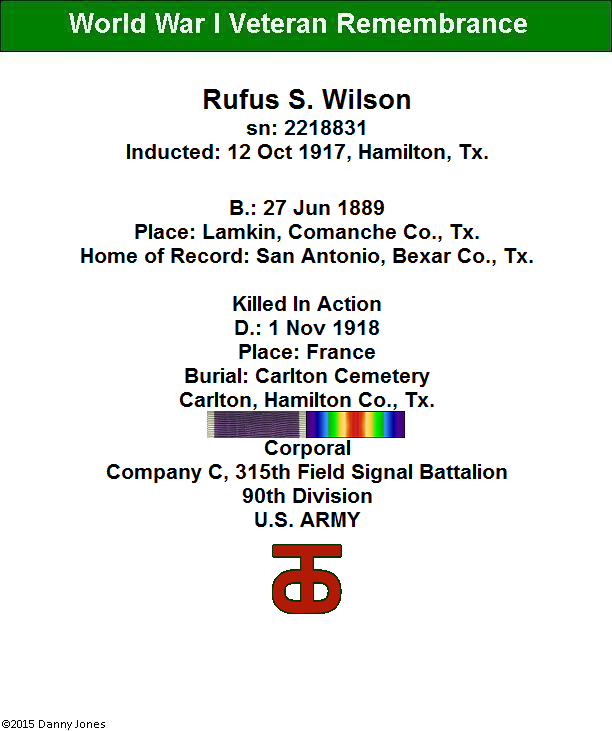
Mr. Rufus Shockley Wilson, a single white male living in Hamilton, Hamilton County, Texas and working as a telephone worker for Texas Telephone Company of Austin as of June 5, 1917. Rufus was of medium height and medium build and had brown hair and blue eyes. Born in Comanche County, June 27, 1889 to John C. and Margaret Wilson, and raised there in Comanche County. Rufus's father died in 1896. Rufus is reported living with his mother in her brother's home, Tom J. Shockley, in JP3 Comanche County, Texas in the 1900 census. Rufus is reported living with his mother and a brother in JP8 Hamilton County, Texas in the 1910 census. Rufus's mother is listed on his Army record as next of kin living at Hamilton, Texas.
Rufus was drafted into active federal service for the US Army on October 12, 1917 at Hamilton, Texas. Rufus Wilson was sent to boot camp at Camp Travis in San Antonio. Private Wilson was in Camp Travis for training with the 69th Company 18th Training Battalion 165th Depot Brigade until he was reassigned to the 55th Company 14th Training Battalion on October 13, 1917. On November 14, 1917 Rufus was still in Camp Travis and he was transferred to the Company C 315th Field Signal Battalion in the 90th Infantry Division. Rufus was promoted Corporal February 10, 1918. Rufus's battalion moved out to Camp Mills New York and then to the port of embarkation in Hoboken New Jersey and boarded the transport ship to England on June 28, 1918 for the eleven day voyage to England. But then, only a few days after reaching England Rufus's company entered France and spent time training near Rouvres France for six weeks at eight hours per day. On August 19, 1918, the division moved to the vicinity of Toul. This move was scarcely completed when the division was ordered to relieve the 1st Division in the line in the Villers-en-Haye sector north of Toul, which was completed on August 24, 1918.
The 90th division's St. Mihiel operation was September 12-16, 1918. The division remained in line in the Puvenelle sector until October 10, 1918. Meuse-Argonne operations October 13 to November 11, 1918. The division was under fire August 20, 1918 to November 11, 1918, they were advancing when halted by the armistice. During the Argonne Forest operations Corporal Wilson was killed in action on November 1, 1918. His mother was notified in Hamilton, Texas.
Corporal Rufus S. Wilson was buried in a temporary grave there in France to be later repatriated to America. The Graves Registration Service of the US Army was Rufus's new unit. The GRS did an awesome job during and after the battles of WW1. Rufus's remains were loaded onto the USAT Cantigny in Antwerp, Belgium on July 21, 1921 and arrived in Hoboken New Jersey on August 1, 1921. Then shipped August 12, 1921 by train to Carlton, Texas arriving August 16, 1921. Rufus Wilson was laid to rest in the Carlton Cemetery at Hamilton County, Texas. Survived by his mother.